


What Service Do Business Class Private Aircraft for Medical Transportation Offer?


If you’re weighing options for a medically supervised transfer, Business Class Private Aircraft offer a thoughtful middle ground between commercial airline stretchers and full ICU air ambulances. In the right cases, they combine clinical oversight with more comfortable seating, flexible timing, and discreet handling – often at a lower cost than an air ambulance. Below, we explain what this service includes in a medical context, how TKP Medical Assistance manages bedside-to-bedside continuity, how routes and documents are prepared, how to decide between transport modes, and what families most often ask.

What “Business Class Private Aircraft” Means in a Clinical Context
In medical transportation, Business Class Private Aircraft refers to a privately operated aircraft configured with a business-class cabin and adapted to carry medically stable patients under professional supervision. Unlike a commercial airline stretcher, this approach does not require airline approvals or removal of seats on a scheduled carrier. Unlike an air ambulance jet, it doesn’t replicate a full onboard ICU. Instead, it provides:
• Spacious business-class seating for patients who can tolerate sitting upright for a defined window (typically 30 – 45 minutes at a time for takeoff and landing).
• A controlled, quieter cabin with flexible departure times, minimizing long layovers and crowded terminals.
• Onboard medical escorts, monitoring equipment, oxygen, medications, and supplies tailored to the patient’s condition.
• Discreet, predictable handling with less administrative friction than commercial solutions.
This model suits post-stabilization transfers; oncology and cardiology patients who are stable but need monitoring; recent postoperative patients cleared to fly in a seated position; and complex chronic cases that benefit from medication administration and vigilance without the intensity of an ICU. When a patient requires continuous supine positioning, advanced ventilation, ECMO, or high-dose vasoactive support, TKP recommends switching to a dedicated air ambulance jet.
How TKP Medical Assistance Delivers Bedside–to–Bedside Care
Since 2001, TKP Medical Assistance has coordinated more than 10,000 international transfers spanning ICU, ECMO, and VIP support. Our model centers on continuity: one team plans, executes, and hands over each case to the receiving hospital. We offer multiple modes to match clinical need, route complexity, and timing:
• Business Class Private Aircraft with medical escort for hemodynamically stable patients who can sit upright for takeoff and landing.
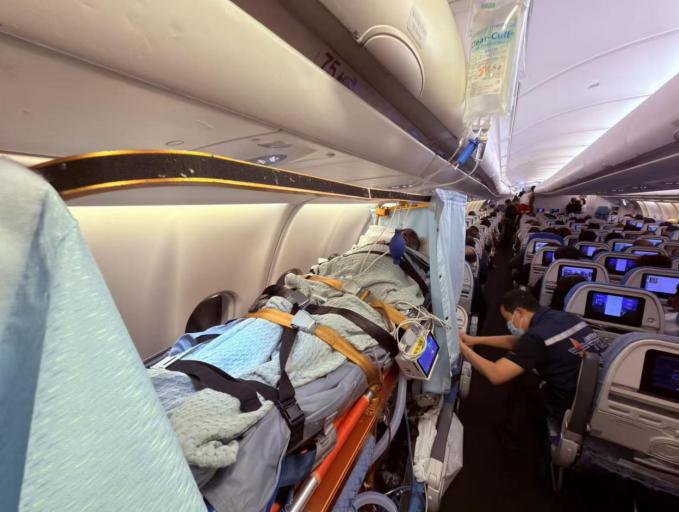
• Commercial airline stretcher programs for patients needing a horizontal position on scheduled flights, subject to airline acceptance.
• Air ambulance jets for critical or unstable cases requiring an onboard ICU and advanced life support.
• Integrated ground ambulances and high-speed rail to bridge airports, remote hospitals, or regions with limited runway options.
• Post-stabilization planning that balances clinical risk, speed, cost, and visa feasibility.
At the planning stage, our clinicians review the medical summary, medications, oxygen demand, and mobility limits. We then align the aircraft configuration and escort level with the patient’s status and the regulatory requirements of departure and destination.
Clinical Escort Care and In–Flight Safety
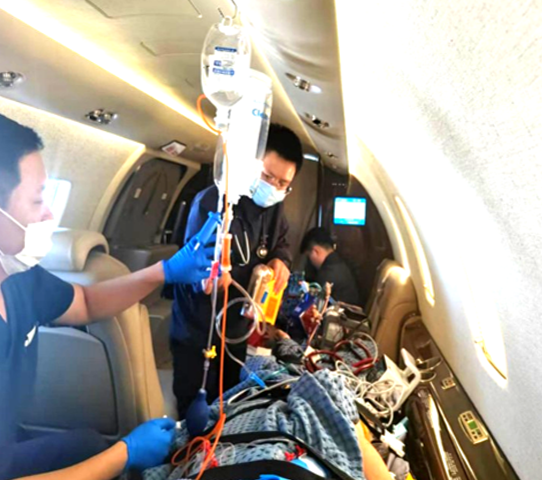
Every Business Class Private Aircraft mission is staffed with an experienced medical escort – typically a flight nurse; for higher-acuity cases, a physician joins. The team’s responsibilities include:
• Pre-flight fitness-to-fly verification, medication reconciliation, and oxygen calculations (including contingency for delays).
• Airworthiness checks for clinical devices; approved batteries; cabin power availability (infusion/monitoring).
• Risk-based DVT prophylaxis, analgesia, symptom control, and continuous vitals surveillance.
• Predefined escalation and diversion pathways for in-flight clinical change.
Pressurization/altitude integrated into the mission plan; certain respiratory/ENT cases may require oxygen or a different transport platform. TKP’s clinical governance ensures the care level is proportionate to patient status and route complexity; when thresholds are exceeded, we pivot to an air ambulance jet.

Route Design, Airport Selection, and Diplomatic Coordination
Speed is only valuable when paired with safety. TKP’s operations team designs routes that respect the clinical picture and the realities of cross-border travel:
• Airport selection that reduces transfers and ramps congestion; when necessary, we leverage airports with minimal infrastructure to reach underserved regions.
• Scheduling that fits the patient’s readiness, balances duty times, and anticipates weather, airspace restrictions, and curfews.
• Real-time flight tracking with the ability to adjust routing for medical or operational reasons.
• Coordination with receiving hospitals so beds and specialists are ready on arrival.
• Close work with embassies and consulates to expedite overflight permissions, landing clearances, and medical visas or humanitarian permits.
Many destinations require 24 – 72 hours to process medical entry documents. Early initiation of documentation prevents a stabilized patient from waiting unnecessarily.
Preparing the Paperwork and the Patient
Well-prepared cases move faster. TKP guides families and coordinators through a targeted checklist:
• Medical documentation: recent summaries, diagnosis, imaging reports if relevant, current medications and dosages, treating physician contact, and – when required – a medical information form or fit-to-fly letter. English translations reduce cross-border friction.
• We’ll make sure you have the right travel papers: passports, IDs for anyone traveling with you, visas for all countries you pass through, and documents for minors (like birth certificates or parental permissions).
• We’ll confirm your insurance details and any pre-approvals. If you’re paying yourself, we may need a deposit and a consent form.
• You’ll choose a main decision-maker and a backup who can be reached at any time.
• Tell us about any special needs: oxygen flow, mobility aids or wheelchair size, food preferences, language or cultural needs, and any implanted medical devices.
We’ll guide you on airline rules for medical device batteries, what’s allowed with liquid oxygen, and how we’ll back up your power. TKP can also arrange invitation letters, hospital acceptance, and work with embassies so documents don’t cause delays.
Choosing Between Transport Methods
Selecting the right mode is a clinical and logistical decision. TKP helps families and insurers avoid both over-specifying (paying for an ICU that isn’t required) and under-specifying (risking a deterioration mid-journey).
• Use private business-class charter when: patient stable; upright for taxi/takeoff/landing; monitoring and medication supported; schedule/privacy prioritized.
• Use commercial stretcher when: continuous supine positioning required; airline fit-to-fly confirmed; carrier operational approval achievable within window.
• Use air ambulance jet when: instability anticipated/observed; airway support beyond supplemental O2; invasive monitoring/ICU interventions required.
Cost, urgency, airport availability, and visa timelines all influence the decision. TKP provides side-by-side options that clarify trade-offs in time, safety margins, and budget.

Frequently Asked Questions
• How quickly can we launch?
Business Class Private Aircraft can often be readied faster than commercial stretcher solutions because they do not depend on airline seat reconfiguration or limited stretcher slots. For time-critical, life-threatening scenarios, a dedicated air ambulance jet remains the fastest path.
• Can a family member travel with the patient?
In most Business Class Private Aircraft transfers, one accompanying relative is feasible, subject to weight and balance, cabin layout, and the clinical plan. TKP confirms this during planning and clarifies luggage limits to keep medical equipment prioritized.
• What affects the price?
The price depends on the aircraft we use and how far it needs to fly, any extra flight time to position the plane, ground ambulances, the type of medical team traveling with you, how much oxygen and equipment are needed, airport fees, flight permits, and how complex the visa process is. TKP provides clear quotes and, when possible, offers safe alternatives that may reduce cost.
• What challenges come up, and how do we handle them?
- Getting airline approvals and stretchers can be slow; if you qualify, a private flight avoids those delays.
- Visas can take time; sending documents early and explaining the medical need helps speed decisions.
- Some airports don’t allow late-night flights; we schedule around curfews or use nearby airports.
- Many vendors can mean more handoffs; TKP coordinates everything from start to finish and monitors your case in real time.
- Sharing medical information across borders is sensitive; we use secure systems and share only what the receiving doctors need.
• How discreet is the process?
Private terminals and ground-side transfers are standard where available. Business Class Private Aircraft allow for minimal public exposure, benefiting high-profile NBIs and families seeking privacy.
• Why TKP for Business Class Private Aircraft?
Depth of experience matters in edge cases. TKP’s clinicians and operations specialists have navigated remote airfields, complex comorbidities, and dynamic border policies. That experience reduces avoidable delays and keeps the focus on patient safety and comfort.
Call to Action
If you need safe, timely, and clinically supervised international transport, TKP Medical Assistance can help. Our team will evaluate medical status, advise whether Business Class Private Aircraft or an air ambulance is the right fit, build a compliant route, coordinate visas and hospital acceptance, and oversee the bedside-to-bedside handover. Contact us to plan the next step – swiftly, securely, and with continuous bedside-to-bedside care.
Submit Your Request
Recent Posts

Tags
- Air Ambulance
- Bedside To Bedside
- Cross Border Aid
- Emergency Evacuation
- Global Medical Rescue
- How can I ensure the patient's stability while in the air?
- How do I request an air medical transport?
- How is it different from an air ambulance
- how to activate emergency aircraft service
- how to request an air ambulance
- Is air medical transport safe
- Is international transport possible
- Medical Rescue
- Medical Transport
- Patient Repatriation
- Remote Rescue
- Seamless Coordination
- Telemedicine Support
- Tourists And Expats Medical Escort
- What are the benefits of a cross-border medical transfer
- What are the different types of transfers
- What are typical use cases
- What documents do I need to prepare for a transfer?
- What does high-speed rail patient transfer stands for
- What is air ambulance
- What is air medical transport?
- What is cross-border medical transfer
- What is emergency aircraft
- what is high-speed rail patient transfer
- What is medical charter flight
- what is neonatal ICU transfer
- What is patient air transfer
- What medical equipment is available on board the aircraft
- What situations shouldn't use air medical transport?
- What types of air ambulance are there?
- What types of air ambulance exist
- What's the difference between international and domestic transfers?
- what’s the difference between air medical transport and regular ambulance?
- When is emergency air transport necessary
- Which patients require air medical transport?
- who is included in the medical team
- who needs an air ambulance