


Young Man with Aortic Dissection Transferred to Prince of Wales Hospital by TKP Medical Escort


A 32-year-old man suffering from a life-threatening aortic dissection was safely transferred from Zhongshan to Hong Kong's Prince of Wales Hospital under continuous arterial blood pressure monitoring and intravenous blood pressure control. TKP Medical Assistance ensured a seamless and stable cross-border transfer.
Aortic Dissection in a Young Hypertensive Patient
Aortic dissection is a critical cardiovascular emergency in which a tear in the inner lining of the aorta allows blood to enter the aortic wall, separating its layers. If left untreated, it has a high fatality rate.
Ah-Kwun, a 32-year-old Hong Kong resident working in Zhongshan, had a history of poorly managed hypertension. After several nights of poor sleep, he developed chest and abdominal pain that rapidly worsened. A CT angiogram revealed extensive intramural hematoma of the thoracoabdominal aorta and multiple dissection flaps. The hospital lacked the capacity for definitive aortic surgery, and his family contacted TKP Medical Assistance for transfer to a specialized center in Hong Kong.
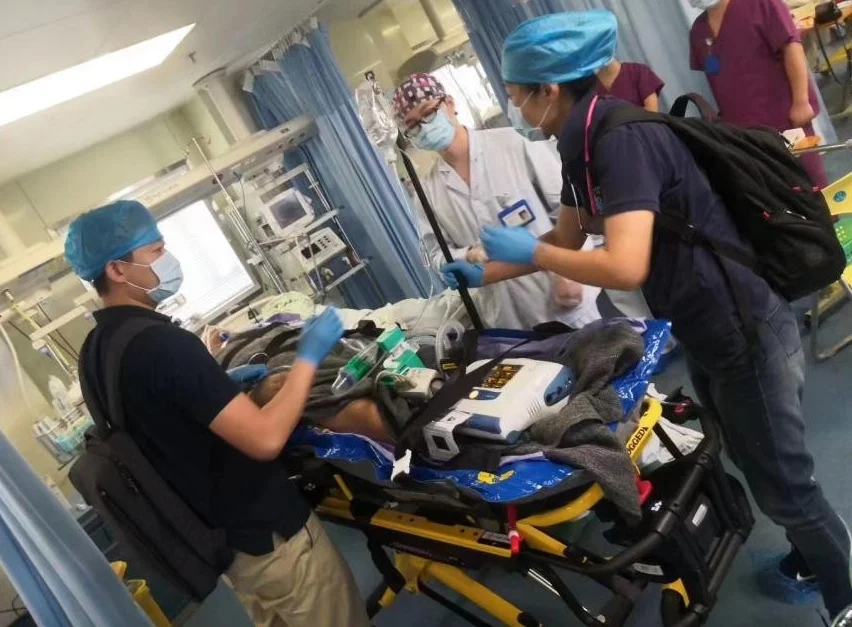
TKP team assessing and transferring the patient onto the ambulance
Advanced In-Transit Monitoring and Blood Pressure Management
Considering the risk of dissection progression toward the ascending aorta—which could cause cardiogenic shock or cerebral ischemia—the TKP medical team formulated a detailed transfer protocol. The plan included advanced monitoring: ECG, direct arterial pressure via radial artery catheterization, continuous IV infusion of nicardipine and metoprolol to control blood pressure and heart rate, and morphine for pain relief.
Upon arrival at the hospital in Zhongshan at 4:00 PM, the TKP team initiated pre-transfer stabilization. The patient was advised to remain still to avoid increased shear stress on the aorta. With careful monitoring, the ambulance departed for Shenzhen Bay Port.
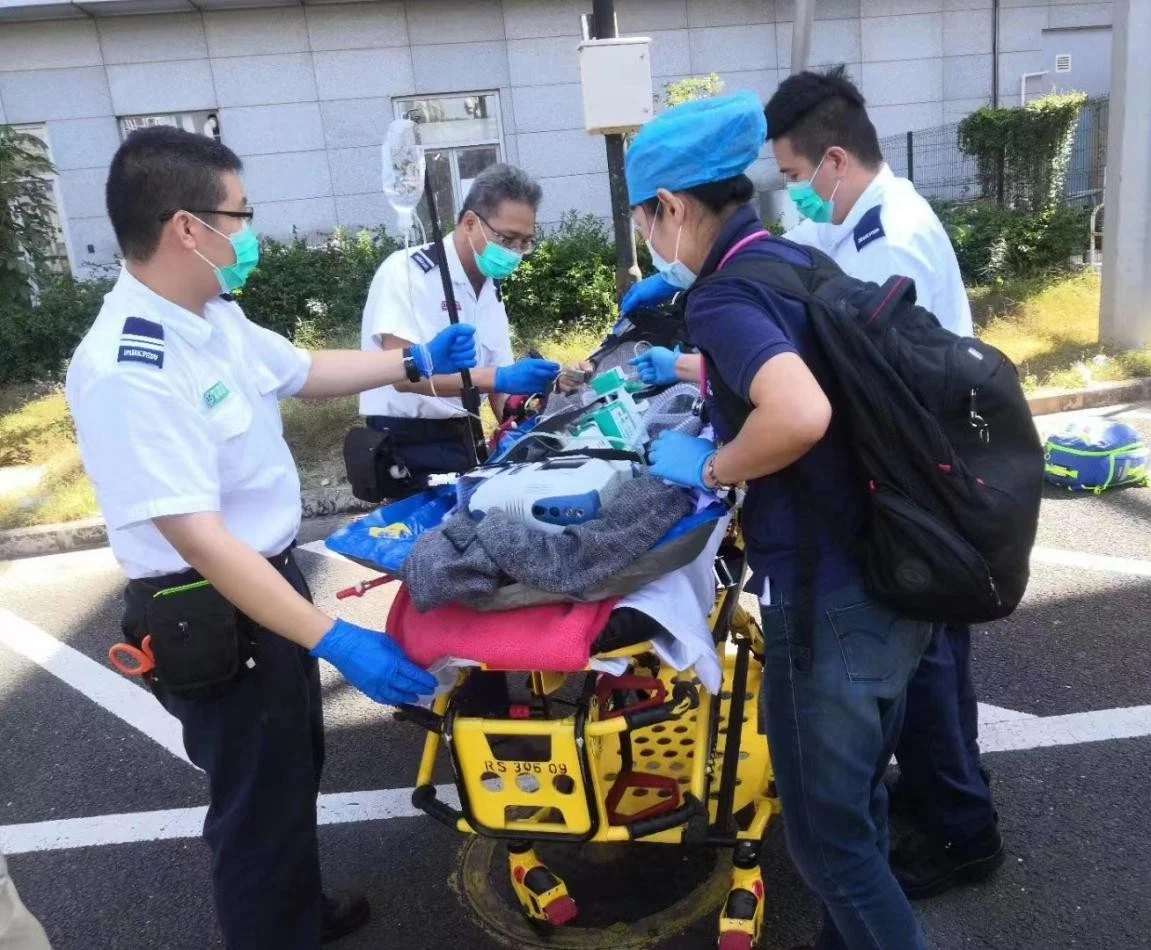
Ambulance switch at Shenzhen Bay Port
Cross-Border Transfer to Specialized Cardiac Care in Hong Kong
At approximately 6:00 PM, the team arrived at Shenzhen Bay Port, completed customs procedures, and transferred the patient to a Hong Kong ambulance. TKP’s physician and nurse continued escorting the patient throughout the journey.
By 7:30 PM, the ambulance reached Prince of Wales Hospital in Hong Kong. The TKP team handed the patient over to the Accident & Emergency Department medical staff. The patient’s family, visibly relieved, praised the team for their professionalism and care.
Frequently Asked Questions
Need help understanding how international medical rescue works? Browse our most common questions to learn about service coverage, response times, documentation requirements, and more. We’re here to support you every step of the way.
Q: Which countries are covered by the cross-border medical rescue service?
A: We cover major countries and regions worldwide to ensure timely rescue
Q: How can I request cross-border medical rescue?
A: Please submit an emergency rescue request through our official website or customer service.
Q: What documents are needed for medical rescue?
A: Patient ID, medical diagnosis report, and emergency contact information are required.
Q: How is the rescue service fee settled?
A: Fees can be paid via insurance claims or direct payment for the service.
Q: How quickly does the rescue response start?
A: In emergencies, rescue operations typically begin within a few hours.
Submit Your Request
Recent Posts

Tags
- Air Ambulance
- Bedside To Bedside
- Cross Border Aid
- Emergency Evacuation
- Global Medical Rescue
- How can I ensure the patient's stability while in the air?
- How do I request an air medical transport?
- How is it different from an air ambulance
- how to activate emergency aircraft service
- how to request an air ambulance
- Is air medical transport safe
- Is international transport possible
- Medical Rescue
- Medical Transport
- Patient Repatriation
- Remote Rescue
- Seamless Coordination
- Telemedicine Support
- Tourists And Expats Medical Escort
- What are the benefits of a cross-border medical transfer
- What are the different types of transfers
- What are typical use cases
- What documents do I need to prepare for a transfer?
- What does high-speed rail patient transfer stands for
- What is air ambulance
- What is air medical transport?
- What is cross-border medical transfer
- What is emergency aircraft
- what is high-speed rail patient transfer
- What is medical charter flight
- what is neonatal ICU transfer
- What is patient air transfer
- What medical equipment is available on board the aircraft
- What situations shouldn't use air medical transport?
- What types of air ambulance are there?
- What types of air ambulance exist
- What's the difference between international and domestic transfers?
- what’s the difference between air medical transport and regular ambulance?
- When is emergency air transport necessary
- Which patients require air medical transport?
- who is included in the medical team
- who needs an air ambulance