


Critically Ill Patient with Pulmonary Hypertension Airlifted to National Center with ECMO + IABP Support


A 46-year-old male with severe pulmonary hypertension and multi-organ failure was successfully transferred from Gaozhou to the National Center for Respiratory Medicine in Guangzhou via medical helicopter. Supported by ECMO and IABP, the transfer was safely executed by TKP Medical Assistance, marking another milestone in high-acuity air medical transport.
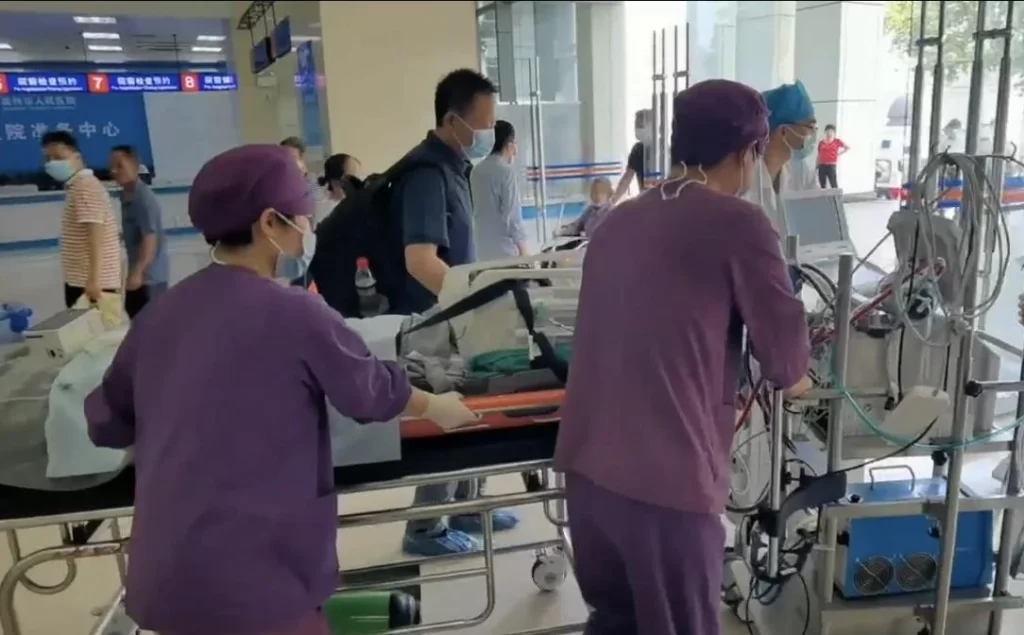
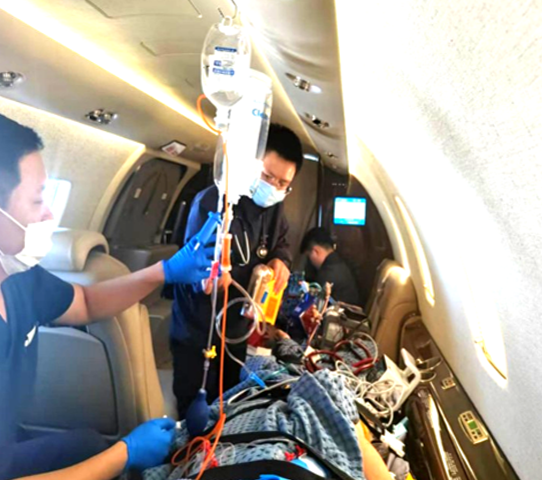
TKP medical experts coordinate with Gaozhou People’s Hospital staff to prepare the patient for transfer under ECMO and IABP support
A Life on the Edge: Pulmonary Hypertension Leads to Cardiopulmonary Collapse
Mr. Lin, a 46-year-old resident of Gaozhou, was diagnosed with idiopathic pulmonary arterial hypertension and advanced heart failure (NYHA Class IV). His condition rapidly deteriorated, leading to multi-organ dysfunction and loss of consciousness. Despite endotracheal intubation and ICU admission, conventional treatments failed to stabilize his circulatory and respiratory systems. The local cardiac surgery team initiated Veno-Arterial ECMO (VA-ECMO) combined with Intra-Aortic Balloon Pump (IABP) support—a rare and aggressive life-saving intervention in regional hospitals.
Recognizing the need for advanced intervention, Mr. Lin’s family contacted TKP Medical Assistance on May 16, seeking emergency transfer to the National Center for Respiratory Medicine at Guangzhou Medical University First Affiliated Hospital.
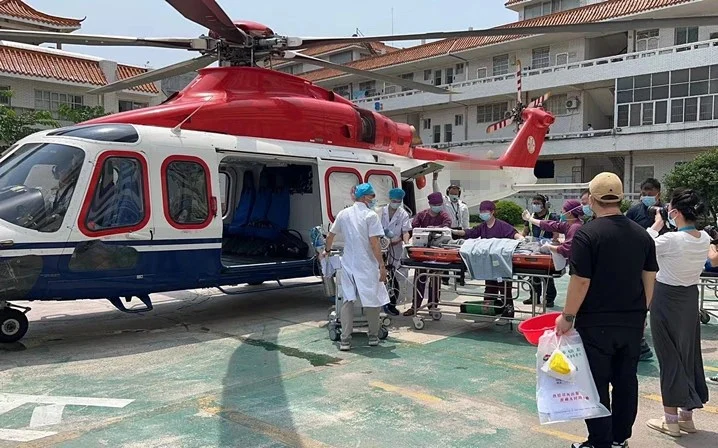
The critically ill patient is carefully loaded into the medevac helicopter, with all life-support systems operational and secured
TKP Launches Rapid Medical Coordination and Airlift Protocol
Upon receiving the request, TKP dispatched a critical care medical team to Gaozhou the following day. Led by senior physician Dr. Cao Guohui, the team conducted a detailed bedside evaluation, confirming that the patient was hemodynamically stable under combined ECMO+IABP+ventilator support—meeting the minimum criteria for helicopter transfer.
TKP activated its “Aerial Rescue Protocol” and coordinated with CITIC Offshore Helicopter Co. to secure a dedicated medevac helicopter. Given the complexity of the patient’s condition and the absence of onboard hospital infrastructure in civilian helicopters, the success of the mission relied entirely on TKP’s self-sufficient, in-flight critical care capabilities.
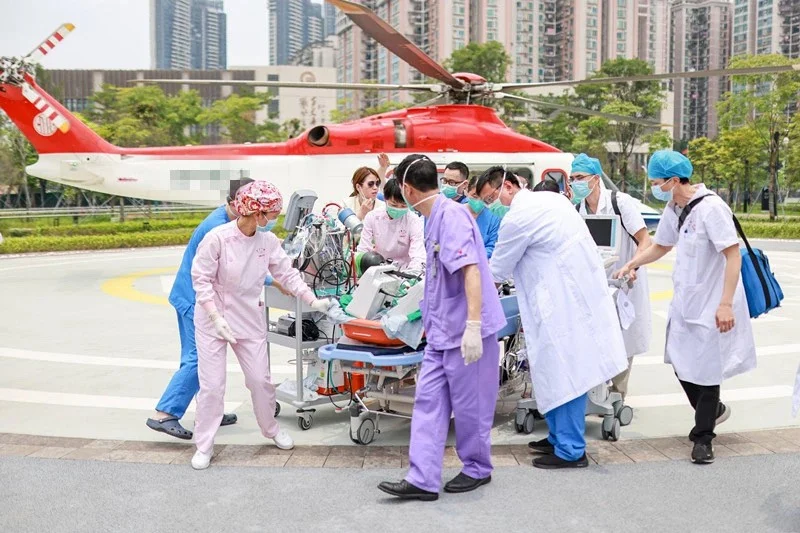
TKP specialists hand over the patient to the ICU team at the National Center for Respiratory Medicine upon helicopter landing
Successful Airlift to Guangzhou Under Full Life Support
In the early morning of May 18, after final checks and cross-disciplinary coordination with Gaozhou People’s Hospital, TKP medical personnel loaded the patient into the helicopter and initiated the flight to Guangzhou.
Upon arrival at the helipad of the National Center for Respiratory Medicine, the patient was swiftly transferred to ICU, where the hospital’s ECMO team took over. The entire mission demonstrated not only speed and precision, but also TKP’s capacity to execute ultra-high-risk inter-facility transfers involving multiple advanced life support modalities.
This case was featured on the official WeChat account of the National Center for Respiratory Medicine, highlighting the collaboration between local hospitals and professional medevac services like TKP in building a regional high-dependency air transport network.
Frequently Asked Questions
Need help understanding how international medical rescue works? Browse our most common questions to learn about service coverage, response times, documentation requirements, and more. We’re here to support you every step of the way.
Q: Which countries are covered by the cross-border medical rescue service?
A: We cover major countries and regions worldwide to ensure timely rescue
Q: How can I request cross-border medical rescue?
A: Please submit an emergency rescue request through our official website or customer service.
Q: What documents are needed for medical rescue?
A: Patient ID, medical diagnosis report, and emergency contact information are required.
Q: How is the rescue service fee settled?
A: Fees can be paid via insurance claims or direct payment for the service.
Q: How quickly does the rescue response start?
A: In emergencies, rescue operations typically begin within a few hours.
Submit Your Request
Recent Posts
Tags
- Air Ambulance
- Bedside To Bedside
- Cross Border Aid
- Emergency Evacuation
- Global Medical Rescue
- How can I ensure the patient's stability while in the air?
- How do I request an air medical transport?
- How is it different from an air ambulance
- how to activate emergency aircraft service
- how to request an air ambulance
- Is air medical transport safe
- Is international transport possible
- Medical Rescue
- Medical Transport
- Patient Repatriation
- Remote Rescue
- Seamless Coordination
- Telemedicine Support
- Tourists And Expats Medical Escort
- What are the benefits of a cross-border medical transfer
- What are the different types of transfers
- What are typical use cases
- What documents do I need to prepare for a transfer?
- What does high-speed rail patient transfer stands for
- What is air ambulance
- What is air medical transport?
- What is cross-border medical transfer
- What is emergency aircraft
- what is high-speed rail patient transfer
- What is medical charter flight
- what is neonatal ICU transfer
- What is patient air transfer
- What medical equipment is available on board the aircraft
- What situations shouldn't use air medical transport?
- What types of air ambulance are there?
- What types of air ambulance exist
- What's the difference between international and domestic transfers?
- what’s the difference between air medical transport and regular ambulance?
- When is emergency air transport necessary
- Which patients require air medical transport?
- who is included in the medical team
- who needs an air ambulance