


Why Emergency Air Medical Evacuation Is a Lifeline Abroad


Travel opens doors, but risk travels too. When crisis strikes far from home, minutes matter. Emergency Air Medical Evacuation turns distance into a plan. It brings care to the patient, then moves the patient to the right hospital. It clears language gaps and fast-tracks approvals. Families get a path, not just a flight. But what happens at 3 a.m. on a remote runway? Who keeps a ventilator steady at 30,000 feet? And what if weather shuts the first airport? In the next section, we lift the curtain – and reveal why this lifeline can decide the outcome.

Why It Matters When You‘re Far From Home
Serious illness or injury abroad magnifies every problem. Local hospitals may be full or lack advanced therapies. Permissions, flight approvals, and bed availability can shift by the hour. Families face unfamiliar paperwork, differing medical standards, and conflicting advice. In this setting, Emergency Air Medical Evacuation is not just transportation. It is a complete care pathway that links bedside to bedside.
At TKP Medical Assistance, we focus on post-stabilization critical transfers and time-sensitive evacuations. Our caseload spans premature infants, postoperative neonates, and pediatric patients with congenital or respiratory conditions. Adult patients may also require ventilatory support, high-acuity monitoring, and continuous medication management. The common pain point is continuity. When care breaks during the journey, risk rises. Our solution is continuous, ICU-level escort care from the first handover to the last.
• When Minutes and Miles Matter
Emergencies rarely align with perfect logistics. Borders, night operations, or scarce equipment can delay movement. We reduce these risks by pairing real-time route planning with decisive clinical leadership. Communication is clear and consistent in Mandarin, English, and Cantonese, so authorizations move faster and handovers stay precise when every minute counts. This is how Emergency Air Medical Evacuation protects patients when distance and time work against them.
• Continuity Is the Cure for Risk
Evacuation is only safe when therapy never pauses. Our teams pre-check equipment, confirm oxygen and power availability, and align each flight segment with the patient’s clinical needs. The objective is simple: keep the standard of care stable, even as geography changes.
How TKP Delivers Emergency Air Medical Evacuation
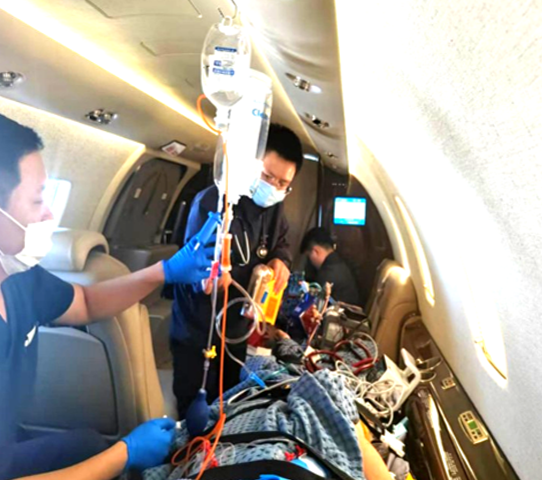
We deploy ICU/ER-trained medical escorts with deep in-flight experience. Each mission is tailored to the patient’s condition, from medication protocols to cabin environment. Our teams support ECMO, IABP, ventilators, infusion pumps, and specialized pediatric devices across the entire journey, including international flight segments. This detail matters for neonatal air ambulance transport, where small changes in temperature, airflow, or noise can affect fragile patients.
1) Critical Care & Neonatal Expertise
We specialize in transfers for premature infants, postoperative neonates, children with congenital heart disease, and pediatric patients in respiratory failure. Each mission is staffed with pediatric specialists and tailored equipment to keep vulnerable patients stable from door to door. Our expertise is trusted by leading hospitals – including Guangzhou Women and Children’s Medical Center – for repeated neonatal transfers across provinces and borders. Consistent outcomes build confidence; trusted partnerships keep pathways open.
• Full support for ECMO, IABP, and other life-sustaining systems across international segments
• Pediatric specialists, incubators, and mission-specific gear for complex neonatal and pediatric cases
• ICU-level medical escort with high-acuity medication and ventilation management in transit
2) Flexible Modes, One Standard
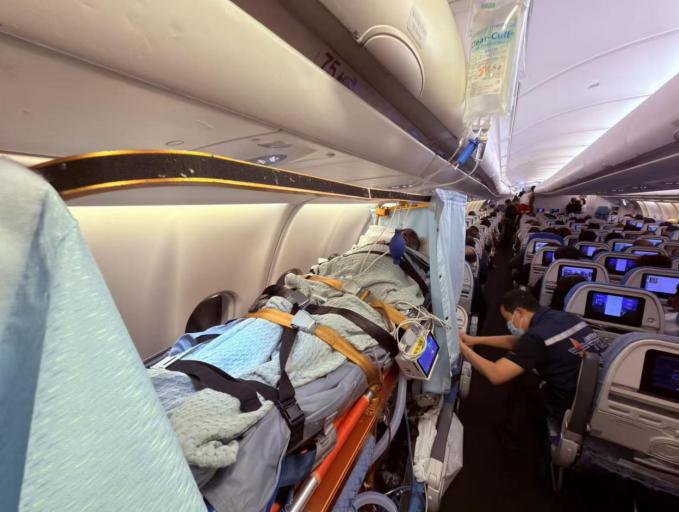
Not every case requires a dedicated air ambulance, and not every airfield can support one. We deliver safe, efficient cross-border transfers through multiple modes – commercial stretcher (with airline approval), dedicated air ambulance, high-speed rail, and ground ambulance. Choosing the right mode reduces cost without weakening safety, especially for bedside-to-bedside medical repatriation after stabilization. One standard guides every choice: maintain clinical integrity from departure to arrival.

Planning That Makes Evacuation Safer – and Faster
Our transfer route map is built for real-world conditions. We link remote or underserved locations to leading medical centers by using strategically selected airports, including those with limited infrastructure. Flight paths are optimized to shorten total travel time and protect patient stability. Behind the scenes, our operations team tracks each mission in real time and adjusts routes promptly for weather, airspace changes, or receiving-hospital readiness. Emergency Air Medical Evacuation succeeds when planning is dynamic but execution is calm.
✅ Real-World Route Planning
• Dynamic flight scheduling matched to patient acuity and urgency
• Global coverage across domestic and international locations
• Access to airports with minimal infrastructure for remote reach
• Optimized routing to reduce flight time and clinical risk
• Close coordination with medical institutions and embassies for smooth handovers
✅ One-Stop Oversight, Clear Communication
Every case follows a closed-loop model led by a dedicated medical coordinator from pre-assessment through arrival. We manage documentation, airline approvals, medical summaries, and bed confirmations. Families and clinicians can focus on what matters – the patient – while we handle every operational detail. Our network spans mainland China, Southeast Asia, Europe, and North America, so handovers remain consistent across jurisdictions and time zones.
What Sets TKP Apart
• ICU-level escort care paired with strict clinical standards
• Multilingual case coordination in Mandarin, English, and Cantonese
• Personalized transport plans – from ECMO to pediatric incubators – built around the clinical reality, not the flight schedule
• Proven cross-border logistics trusted by top pediatric centers
Plan Before You Need It
If you manage international patients – or you travel with higher medical risk – talk to TKP Medical Assistance now. We can pre-assess likely scenarios, outline coverage options, and build a rapid-activation plan for Emergency Air Medical Evacuation. Preparation shortens decision time and protects outcomes when the unexpected happens abroad.
Need urgent guidance today? Contact TKP Medical Assistance for an immediate case review. We will assess the condition, recommend the safest transport mode, and coordinate the receiving hospital – so critical care never pauses between beds. When the path home looks complicated, we make it clear, coordinated, and clinically sound.
Submit Your Request
Recent Posts

Tags
- Air Ambulance
- Bedside To Bedside
- Cross Border Aid
- Emergency Evacuation
- Global Medical Rescue
- How can I ensure the patient's stability while in the air?
- How do I request an air medical transport?
- How is it different from an air ambulance
- how to activate emergency aircraft service
- how to request an air ambulance
- Is air medical transport safe
- Is international transport possible
- Medical Rescue
- Medical Transport
- Patient Repatriation
- Remote Rescue
- Seamless Coordination
- Telemedicine Support
- Tourists And Expats Medical Escort
- What are the benefits of a cross-border medical transfer
- What are the different types of transfers
- What are typical use cases
- What documents do I need to prepare for a transfer?
- What does high-speed rail patient transfer stands for
- What is air ambulance
- What is air medical transport?
- What is cross-border medical transfer
- What is emergency aircraft
- what is high-speed rail patient transfer
- What is medical charter flight
- what is neonatal ICU transfer
- What is patient air transfer
- What medical equipment is available on board the aircraft
- What situations shouldn't use air medical transport?
- What types of air ambulance are there?
- What types of air ambulance exist
- What's the difference between international and domestic transfers?
- what’s the difference between air medical transport and regular ambulance?
- When is emergency air transport necessary
- Which patients require air medical transport?
- who is included in the medical team
- who needs an air ambulance