


What Sets Flight Stretcher Medical Equipment Apart in Aviation Medicine


The Flight Stretcher Medical Equipment plays an important role of the long-distance patient transfer we handle at TKP Medical Assistance. Behind each stretcher case there is a family making hard decisions, a complex diagnosis, and a timeline that often leaves no room for delays. Our job is to turn that pressure into a structured, medically controlled journey that crosses borders safely and smoothly.
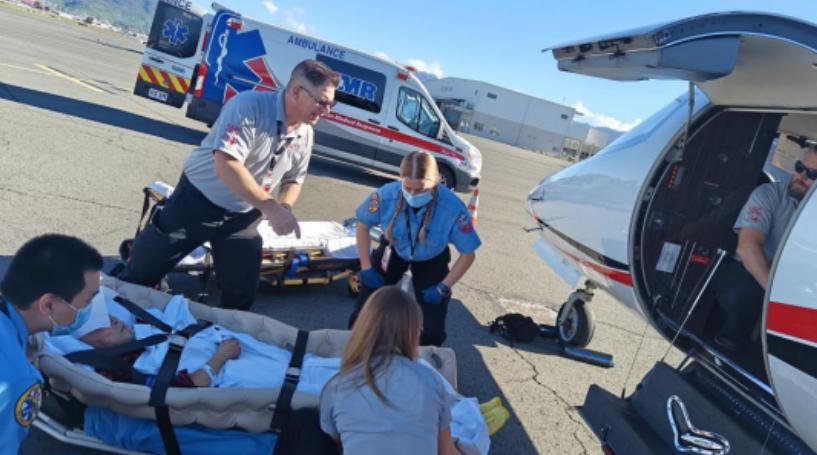
Why Flight Stretcher Medical Equipment Matters in Real Flights
When a patient can no longer sit upright, a regular seat on a plane is not an option. In aviation medicine, Flight Stretcher Medical Equipment allows airlines to transform part of the cabin into a small, dedicated medical space. Instead of chartering a full air ambulance, stable patients can travel on commercial flights, which is often far more cost-effective for families, hospitals, and insurers.
However, the reality on board is much more complex than it looks in a brochure.
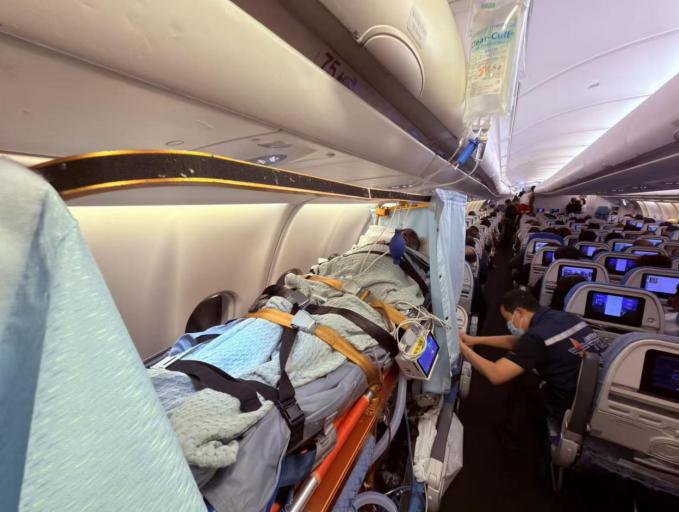
The stretcher is set up in a shared cabin, close to other passengers, cabin crew, and their luggage. For patients with weak immune systems, this can increase exposure to infection. Turbulence can affect how secure the equipment feels and how comfortable the patient is over long hours in the air. If an emergency occurs mid-flight, the response is not instant; medical staff work in a narrow aisle with limited tools, and it can take several minutes to organize support.
On top of that, there are strict limits on what can be used in the air. Most airlines only allow a limited list of FAA-approved devices. Often this includes:
- portable oxygen concentrators with modest flow
- basic cardiac monitoring
- simple infusion pumps
Advanced technologies such as ECMO or hyperbaric systems are usually not allowed on commercial flights at all. Many stretcher services also rely on a single registered nurse, sometimes without a strong critical care background, and then depend on remote physician advice if something changes.
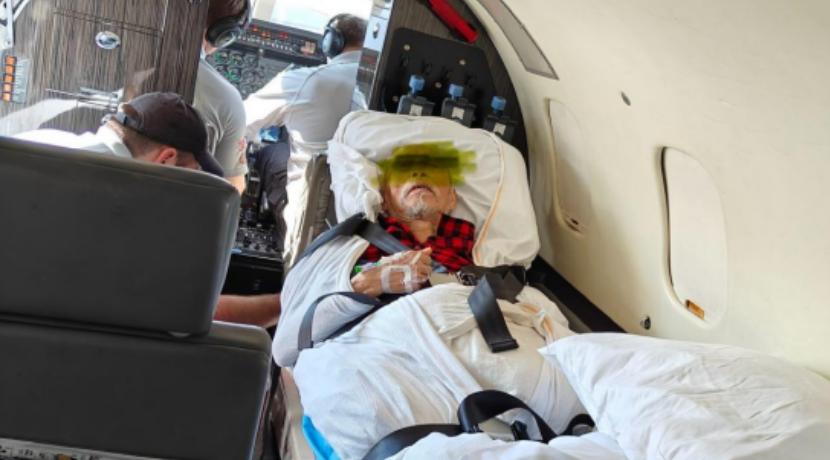
These are not theoretical issues. They are daily pain points in the global stretcher transfer industry. At TKP Medical Assistance, we design every mission around these limitations so that Flight Stretcher Medical Equipment is used in a way that makes sense not just for the airline, but for the patient’s safety from hospital bed to hospital bed.
How TKP Medical Assistance Manages Complex Cross-Border Missions
- A Flight Is Only One Part of the Story
A commercial stretcher transfer is never “just a flight.” It is a chain of carefully timed steps: hospital discharge, ground ambulance to the airport, check-in, stretcher installation, in-flight monitoring, arrival procedures, immigration, and final handover to the receiving facility.
In February 2025, for example, we coordinated a transfer for a patient with a spinal cord injury, tracheostomy, and ventilator-assisted breathing from Chengdu to Eastbourne, via Hong Kong. Our Flight Stretcher Medical Equipment team looked after airway care, humidification, and pressure ulcer prevention from the first ambulance pick-up in China to the last transfer into the UK medical ward. There was no “on/off” switch for medical responsibility; every stage formed part of one continuous treatment corridor.
From the moment our team meets a patient, we build that corridor around three key ideas:
- airway security is checked and stabilized before leaving the hospital
- the same care plan follows the patient through ambulance, airport, and cabin
- the final handover includes detailed documentation and real-time clinical updates
This approach reduces the risk of gaps in care as the patient moves from one team to another, or from one country to another.
Inside the Cabin: More Than “Watching And Waiting“
Once the stretcher is installed and the aircraft doors are closed, the cabin becomes a small airborne ward. Our medical escorts do far more than observe. They adapt treatment to the realities of flight.
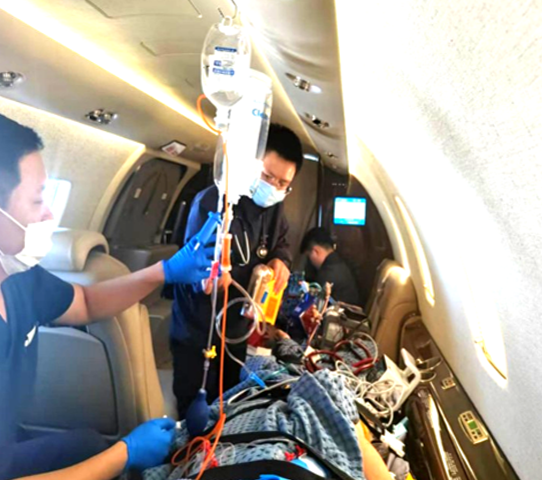
They adjust infusions, sedation, and pain control based on cabin pressure, flight duration, and turbulence. Vital signs are checked in rotation, and every meaningful change is documented. This record supports clinical decisions during the flight and gives the receiving hospital clear insight into what happened in the air.

Because Flight Stretcher Medical Equipment has to function safely in a moving aircraft, we pay close attention to how devices are fixed, how tubing is routed, and how the team will respond if the aircraft hits unexpected turbulence. Simple, practical details – where to place a pump, how to secure a ventilated circuit, when to reposition the patient – have a huge impact on comfort and safety.
- Smarter Routes, Constant Monitoring
Behind each mission, there is a planning team watching over the whole journey. Our operations staff combine medical requirements with airline rules and airport realities to build practical routes.
We use Flight Stretcher Medical Equipment in a network that:
- connects remote or underserved areas with major medical centers
- combines domestic and international flights into one continuous plan
- uses airports with simpler infrastructure when they are the best or only option
- cuts total travel and layover time wherever possible
As flights progress, we monitor the mission in real time. Delays, weather changes, and operational disruptions are treated as clinical factors, not just travel annoyances. If a connection becomes risky, we can adjust the route and keep both the patient and the medical plan protected.
What Sets TKP‘s Flight Stretcher Medical Equipment Service Apart
- Turning Common Risks into Managed Processes
Many providers still view commercial stretcher transfers as standard logistics “plus a nurse.” At TKP Medical Assistance, we treat them as clinical operations that happen to use an aircraft, not as flights that happen to include a patient.
We focus on the main areas where things often go wrong in aviation medicine and build structured responses around them:
✅ Managing shared cabin and infection exposure
We review each case individually and design infection-control measures suited to the patient’s condition. This can include reduced contact with other passengers, PPE for staff, and stricter hygiene protocols during boarding, flight, and disembarkation. The goal is to use Flight Stretcher Medical Equipment without increasing unnecessary infection risk in a shared cabin.
✅ Working within equipment limits, not against them
Instead of discovering restrictions at the check-in desk, we verify in advance what each airline allows. Our team confirms which devices, accessories, and oxygen setups can legally fly on a given route. If a patient’s needs exceed what commercial Flight Stretcher Medical Equipment can support, we openly discuss other options – such as air ambulance or alternative routing – before the mission is confirmed.
✅ Planning for slow emergency response in the air
We know that a narrow aisle and limited crew mean fast emergency response is difficult. That is why we focus on prevention. Stable sedation, careful fluid management, and clear in-flight escalation protocols help reduce the chance of sudden deterioration. Our checklists are built for fast, structured action when there is no time to improvise.
✅ Choosing the right medical team, not just any team
Instead of sending “who is available,” we match skills to the case. Our escorts may bring backgrounds in critical care, respiratory care, neurology, or other relevant specialties. In more complex missions, and where operational rules allow, we can add physician-level support to the team. This helps ensure Flight Stretcher Medical Equipment is used by professionals who know how to respond when conditions change.
For families, this approach turns a frightening journey into a process that feels organized and transparent. For hospitals and insurers, it creates a reliable pathway that respects medical standards, airline rules, and budget constraints at the same time.
If you are arranging a cross-border transfer for a bedridden or ventilator-dependent patient, our Flight Stretcher Medical Equipment specialists at TKP Medical Assistance are ready to support you. Get in touch with us to review your case, compare transport options, and design a safe, efficient bed-to-bed route – so the patient’s journey is not just possible, but properly protected.
Submit Your Request
Recent Posts
Tags
- Air Ambulance
- Bedside To Bedside
- Cross Border Aid
- Emergency Evacuation
- Global Medical Rescue
- How can I ensure the patient's stability while in the air?
- How do I request an air medical transport?
- How is it different from an air ambulance
- how to activate emergency aircraft service
- how to request an air ambulance
- Is air medical transport safe
- Is international transport possible
- Medical Rescue
- Medical Transport
- Patient Repatriation
- Remote Rescue
- Seamless Coordination
- Telemedicine Support
- Tourists And Expats Medical Escort
- What are the benefits of a cross-border medical transfer
- What are the different types of transfers
- What are typical use cases
- What documents do I need to prepare for a transfer?
- What does high-speed rail patient transfer stands for
- What is air ambulance
- What is air medical transport?
- What is cross-border medical transfer
- What is emergency aircraft
- what is high-speed rail patient transfer
- What is medical charter flight
- what is neonatal ICU transfer
- What is patient air transfer
- What medical equipment is available on board the aircraft
- What situations shouldn't use air medical transport?
- What types of air ambulance are there?
- What types of air ambulance exist
- What's the difference between international and domestic transfers?
- what’s the difference between air medical transport and regular ambulance?
- When is emergency air transport necessary
- Which patients require air medical transport?
- who is included in the medical team
- who needs an air ambulance