


How Can I Ensure the Patient’s Stability While in the Air? Guide


What Can I Do to Make Sure the Patient is Stable in the Air?
Air medical transport has proved to be a savior to patients who need urgent, specialized treatment. Health caregivers and family members frequently inquire: How can I make sure that the patient will be stable when on the air? It is a question of preparation, surveillance, and an experienced medical team.
The Importance of Patient Stability in Air Medical Transport
Air transport presents special challenges, as opposed to ground ambulances:
- Alterations of cabin pressure influence oxygen concentration.
- Delicate patients can be upset by turbulence.
- This is because of limited space, which needs intricate preparation.
- Continuous observation is required in long-distance flights.
Comfort is not the only way patient stability is guaranteed, but survival and improved outcomes are.
Pre-Flight Patient Assessment
A thorough pre-flight inspection should be done before boarding. Flight physicians and doctors examine:
- Vital signs stability.
- Oxygen saturation levels.
- Heart disease and arrhythmia.
- Head or spinal injuries.
- Fluid and drug needs.
In this risk assessment, it is determined whether the patient could be fit to be air transported or needs more stabilization before air transport.
ALS in the Air
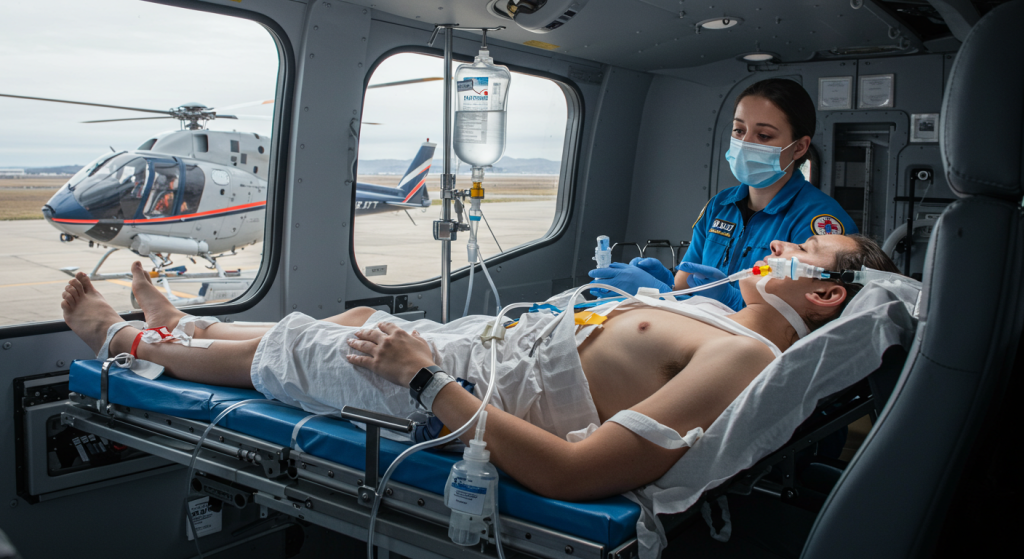
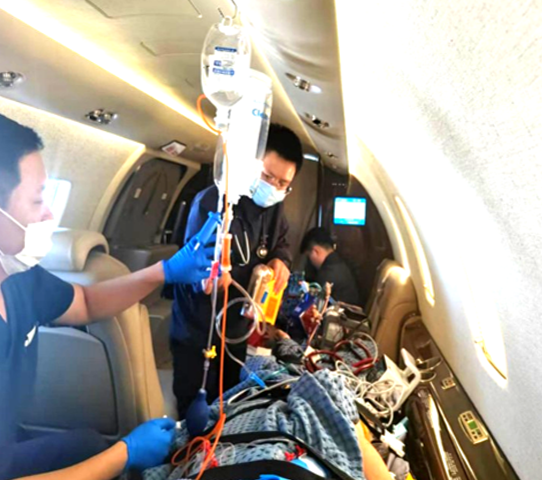
The current air ambulances are flying ICUs. They are equipped with:
- Portable ventilators.
- Cardiologists and defibrillators.
- Medication infusion pumps.
- Emergency response kits.
- Special shock-absorbing stretchers.
How can I ensure the patient’s stability while in the air? Having a highly trained crew means that the vital signs are constantly tracked during the flight. Did you know? The National Association of Air Medical Services documented that more than half a million patients are flown by air ambulances in different parts of the world annually.
Cabin Pressure and Oxygenation
On the higher altitudes, the oxygen levels become low, even in the pressurized cabins. This may be dangerous to the respiratory patients. Solutions include:
- Oxygen supplement.
- Non-invasive ventilation (CPAP/ BiPAP).
- Possibly adjusting cabin pressure.
- Optimization of pre-flight oxygen saturation.
Medical Escort Services
Often, the patients do not require a complete ICU set-up but must have skilled care.
Medical escort services include:
- Patient monitoring from bed to bed.
- Medication management.
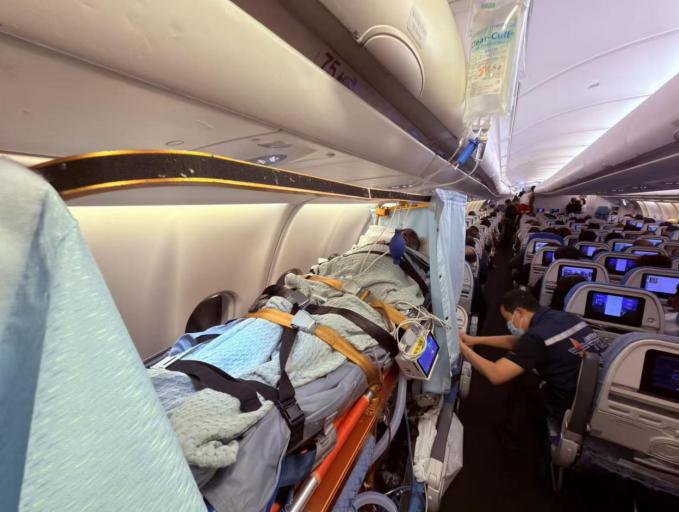
- Stretcher-supported commercial flights.
It is a perfect choice with stable and weak patients. TKP Assistance provides air ambulance services as well as medical escort services, which are safe in all cases.
Tying Down the Patient in Flight
The stability of patients also implies physical safety. It is prevented by the proper securing practice when it is moving during turbulence:
- Special harnessed stretchers.
- Spinal injury patients. Stabilization.
- Shock-absorbing padding.
- Proper insertion of IV lines and equipment.
Managing High-Risk Patients
Some conditions demand additional measures:
- Patients with Cardiac Issues – Constant ECG and defibrillation.
- Neurological Patients – Prevention of complications of high altitude.
- Burn Victims – Austerely infection control.
- Neonates and Pediatrics – Thermally controlled incubators.
Flight crews reduce the risks and maximize the chances of survival by customizing the protocols.
Long-Distance Medical Evacuations
In case of the cross-border or intercontinental transfers, everything is planned.
Factors Include:
- Fueling is not interrupted, but patient stability is not disrupted.
- Medical approvals on international levels.
- Integration of ground ambulance at each end.
- Exchange of information between the departure and arrival hospitals.
Other services, such as TKP Assistance, specialize in the smooth transfer of patients globally as they are kept stable throughout the process.
Safety Standards of Regulations
The air medical transport is regulated by strict rules:
- Medical flight regulations of FAA/EASA.
- EURAMI or CAMTS accreditation.
- Critical care crew training.
Adherence will make sure there is no safety lapse.
Prevention of Infection and Comfort to the Patient
The infection control measures involve:
- Cleaning of equipment.
- Personal protective equipment (PPE).
- Separated rooms for sick people.
Comfort of the Patient is Also Very Critical:
- Temperature regulation.
- Noise reduction headsets.
- Effective communication with families.
Best Practices of Promoting Stability
In conclusion, patient stabilization during air medical transportation is a combination of planning, technology, and professional care. No step is too much in cases of life and death.
- Do a Proper Pre-Flight Evaluation – This involves checking the medical status, risks, and travel preparedness of the patient before boarding the aircraft.
- Install Hi-Tech Monitoring and Life Support Systems – Install hi-tech ICU-grade monitors, ventilators, and infusion pumps on flights and have them constantly operating.
- Control the Oxygen, Cabin Pressure – Adjust oxygen to patients and consider the altitude physiology to ensure that the patients remain stable.
- Special Medical Escort – Critical patients can be assisted by doctors, nurses, or paramedics with aeromedical expertise.
- Physically Restrain the Patient During Turbulence – Additional injury during rough air is avoided through proper restraints and positioning.
- Adhere to the Best Infection Control Practices – Wear sterile needles and observe hygiene to avoid exposing the vulnerable patients.
- Adhere to International Safety Protocols – Compliant with FAA/EASA standards and accepted air ambulance qualifications.
- Easy Ground-Air-Ground Transfers – Handovers are made seamlessly, so that continuity of care occurs until the patient is at the destination.
Through these best practices, medical teams can achieve their highest patient safety and stability during the air, with a safe, efficient, and compassionate transfer.
Conclusion
Therefore, how can I ensure the patient’s stability while in the air? It is all about readiness, technology, and experience. The air medical transport is said to be one of the safest methods of transporting patients over long distances with the right medical team, the right equipment, and the right planning. We are very precise and place our tender with empathy at TKP Assistance, as we have air ambulances, commercial stretcher transfers, and medical escorts. We have only one mission to maintain all the patients stable, safe, and under care, regardless of the destinations of their journeys.
Submit Your Request
Recent Posts

Tags
- Air Ambulance
- Bedside To Bedside
- Cross Border Aid
- Emergency Evacuation
- Global Medical Rescue
- How can I ensure the patient's stability while in the air?
- How do I request an air medical transport?
- How is it different from an air ambulance
- how to activate emergency aircraft service
- how to request an air ambulance
- Is air medical transport safe
- Is international transport possible
- Medical Rescue
- Medical Transport
- Patient Repatriation
- Remote Rescue
- Seamless Coordination
- Telemedicine Support
- Tourists And Expats Medical Escort
- What are the benefits of a cross-border medical transfer
- What are the different types of transfers
- What are typical use cases
- What documents do I need to prepare for a transfer?
- What does high-speed rail patient transfer stands for
- What is air ambulance
- What is air medical transport?
- What is cross-border medical transfer
- What is emergency aircraft
- what is high-speed rail patient transfer
- What is medical charter flight
- what is neonatal ICU transfer
- What is patient air transfer
- What medical equipment is available on board the aircraft
- What situations shouldn't use air medical transport?
- What types of air ambulance are there?
- What types of air ambulance exist
- What's the difference between international and domestic transfers?
- what’s the difference between air medical transport and regular ambulance?
- When is emergency air transport necessary
- Which patients require air medical transport?
- who is included in the medical team
- who needs an air ambulance