


Medical Emergency Transfer for Critical Patients: Proven Solutions


Medical Emergency Transfer For Critical Patients is our daily mission at TKP Medical Assistance, delivered with ICU-level care, precise planning, and clear communication from bedside to bedside.
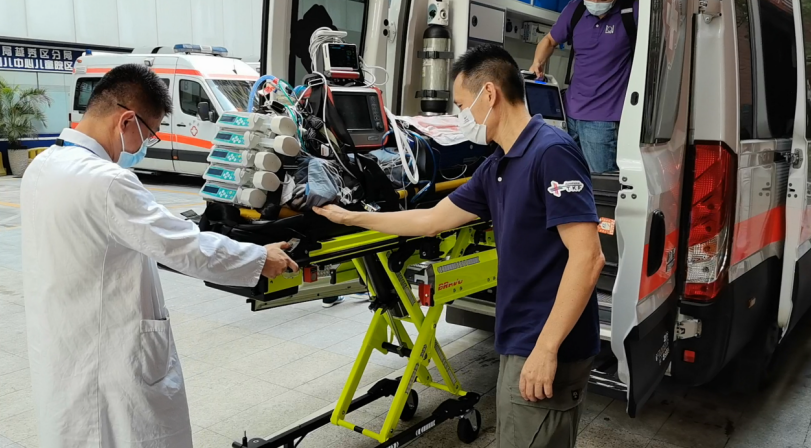
More Than Transport: Continuous ICU Care Across Borders
When a life is unstable, “transport” is not enough. Hospitals and families need continuity – therapies that do not pause, device settings that do not drift, and documentation that tells the patient’s story clearly. Delays at borders, inconsistent handover routines, and equipment mismatches can put that continuity at risk. Our job is to close those gaps. We coordinate early, align expectations with sending and receiving teams, and create a single plan that everyone can follow. The result is a stable arrival and a receiving ICU that knows exactly what happened in the air and on the ground.
1) ICU-Grade Systems on the Move
Our ICU-trained teams manage advanced life-sustaining therapies through every phase of the journey, including international flight segments. That matters when interruptions are not an option and when a patient cannot tolerate equipment swaps or unplanned pauses.
•End-to-end operation of ECMO, IABP, ventilators, and continuous monitoring
•Built-in redundancy and in-flight troubleshooting to prevent therapy interruptions
•Clear, timestamped documentation that the receiving ICU can trust
We keep device settings consistent, verify alarms, and log vital signs in real time. This approach preserves stability and cuts confusion at handover. Long-tail keyword: ECMO transport for neonates.
2) Pediatric & Neonatal Expertise
Children are not small adults. Premature infants, postoperative neonates, pediatric patients with congenital heart disease, and children in respiratory failure need teams and tools designed for them. We staff each mission with pediatric specialists and tailor the kit – incubators, airway sets, humidity and temperature control – to the patient’s age and condition. Our record of repeated neonatal transfers for leading centers – such as Guangzhou Women and Children’s Medical Center – reflects that focus. For families, it means calm briefings and predictable milestones. For hospitals, it means a patient who arrives with stable parameters and a clear clinical timeline.
Route Design & Real-Time Ops for Critical Transfers
Cross-border missions layer clinical demands on top of logistics: visas, permits, aircraft availability, ground legs, and customs checks. We remove friction by designing routes around the patient’s physiology, not just the shortest line on a map. Our operations team watches each flight live and adjusts when circumstances change, keeping the medical plan intact.
✅ Transfer Route Map: From Remote Sites to Centers of Excellence
Our route map connects remote, underserved, or emergency locations to hospitals worldwide. We often choose strategic airports – sometimes with minimal infrastructure – to speed access and avoid congestion. The goal is simple: reduce time to definitive care while protecting the treatment plan.
•Dynamic scheduling matched to condition and urgency
•Global coverage across domestic and international corridors
•Use of airports with minimal infrastructure for faster reach
•Optimized routes to shorten flight time and lower risk
•Close coordination with hospitals and embassies for smooth clearances
✅ Case Snapshot: Chengdu → Eastbourne (February 12, 2025)
• Diagnosis: Post-spinal cord injury with tracheostomy and ventilator-assisted breathing
• Mode: Commercial flight stretcher service with ground ambulance coordination in Europe
The mission began at the bedside in Chengdu. We validated ventilator settings, confirmed the secretion and humidification strategy, and set a sedation plan that would remain stable across handovers. Pressure-injury prevention started before the first lift. Our team supervised every stretcher transition – from ambulance to airport, across the jet bridge, and into the aircraft – ensuring secure positioning and airway protection.
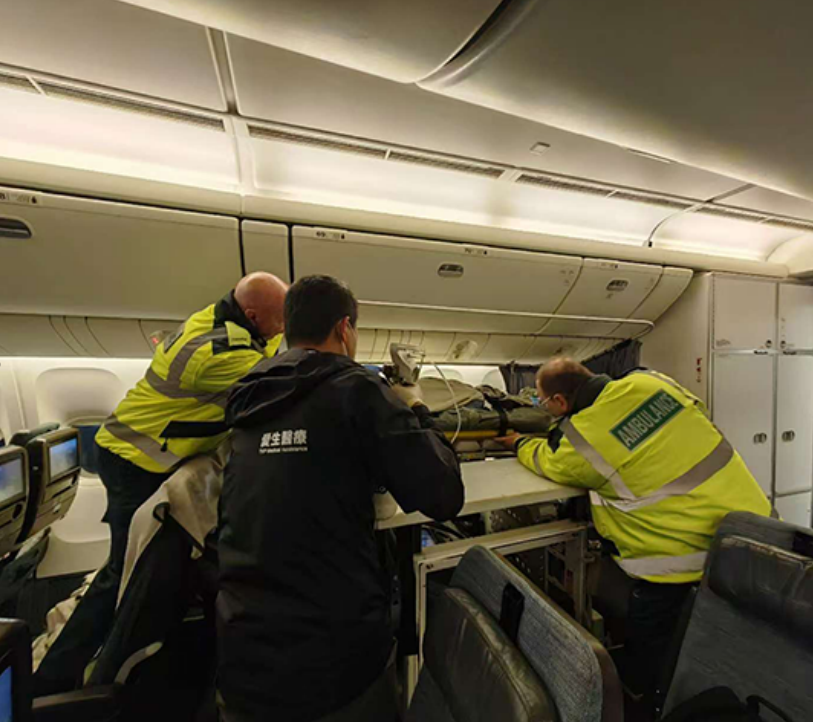
During the flight, nurses adjusted IV rates and sedation to maintain comfort and gas exchange. Vital signs were recorded in rotation, and any change was communicated to the receiving team without delay. Pre-arranged customs and immigration clearance shortened the post-landing timeline. The ground ambulance met the aircraft, and a seamless handover followed: clinical notes, trend charts, ventilator parameters, and sedation records were delivered together so the receiving ICU could continue care without a pause. This is what Medical Emergency Transfer For Critical Patients looks like in practice – steady therapy, clean documentation, and no surprises at the door.
Why Hospitals Choose TKP Medical Assistance
Hospitals choose us because we combine clinical depth with logistics mastery. That combination is what Medical Emergency Transfer For Critical Patients requires when the origin is far away, the border is tight, and the therapy is complex.
✅ Seamless Handover, Documentation, and Safety
Most problems occur during handover or device changeovers. We design missions to avoid those moments or make them safe and fast.
•One command channel – from first call to bedside handover – to prevent mixed messages
•Pediatric, neonatal, and adult critical-care specialists matched to the case profile
•Standardized reports, device setting records, and trend charts for full traceability
•Equipment continuity for ECMO, IABP, ventilation, and monitoring – even across borders
•A proven pattern of neonatal and pediatric transfers for leading hospitals
Beyond equipment and protocols, we pay attention to human factors. Clear roles keep everyone focused. Closed-loop communication reduces errors. Checklists catch small issues before they become big ones. Families are updated at each milestone, which lowers stress and builds trust. For the receiving ICU, our documentation shows precisely what happened and why, so the team can pick up treatment without re-work.
Call to Action
If you need Medical Emergency Transfer For Critical Patients, involve us early. A brief consult with TKP Medical Assistance clarifies route options, ground legs, aircraft setup, and device strategy before the clock starts. We will outline the safest path, list required equipment, and define documentation standards so your receiving team is ready the moment the wheels stop. Contact TKP Medical Assistance for a concise, no-obligation route and equipment assessment – and keep life-sustaining therapies running every mile of the way.
Submit Your Request
Recent Posts
Tags
- Air Ambulance
- Bedside To Bedside
- Cross Border Aid
- Emergency Evacuation
- Global Medical Rescue
- How can I ensure the patient's stability while in the air?
- How do I request an air medical transport?
- How is it different from an air ambulance
- how to activate emergency aircraft service
- how to request an air ambulance
- Is air medical transport safe
- Is international transport possible
- Medical Rescue
- Medical Transport
- Patient Repatriation
- Remote Rescue
- Seamless Coordination
- Telemedicine Support
- Tourists And Expats Medical Escort
- What are the benefits of a cross-border medical transfer
- What are the different types of transfers
- What are typical use cases
- What documents do I need to prepare for a transfer?
- What does high-speed rail patient transfer stands for
- What is air ambulance
- What is air medical transport?
- What is cross-border medical transfer
- What is emergency aircraft
- what is high-speed rail patient transfer
- What is medical charter flight
- what is neonatal ICU transfer
- What is patient air transfer
- What medical equipment is available on board the aircraft
- What situations shouldn't use air medical transport?
- What types of air ambulance are there?
- What types of air ambulance exist
- What's the difference between international and domestic transfers?
- what’s the difference between air medical transport and regular ambulance?
- When is emergency air transport necessary
- Which patients require air medical transport?
- who is included in the medical team
- who needs an air ambulance