


Micro-preemie with Congenital Heart Defects Safely Transferred Through TKP’s “Jump Cloud Plan”


A premature infant born at 27+6 weeks and weighing only 1.4 kg—complicated by congenital heart defects—was successfully transferred from Guilin to Guangdong Provincial People’s Hospital by TKP Medical Assistance via high-speed rail. This case highlights TKP’s specialized neonatal transport service known as the “Jump Cloud Plan,” delivering critical care throughout the journey.
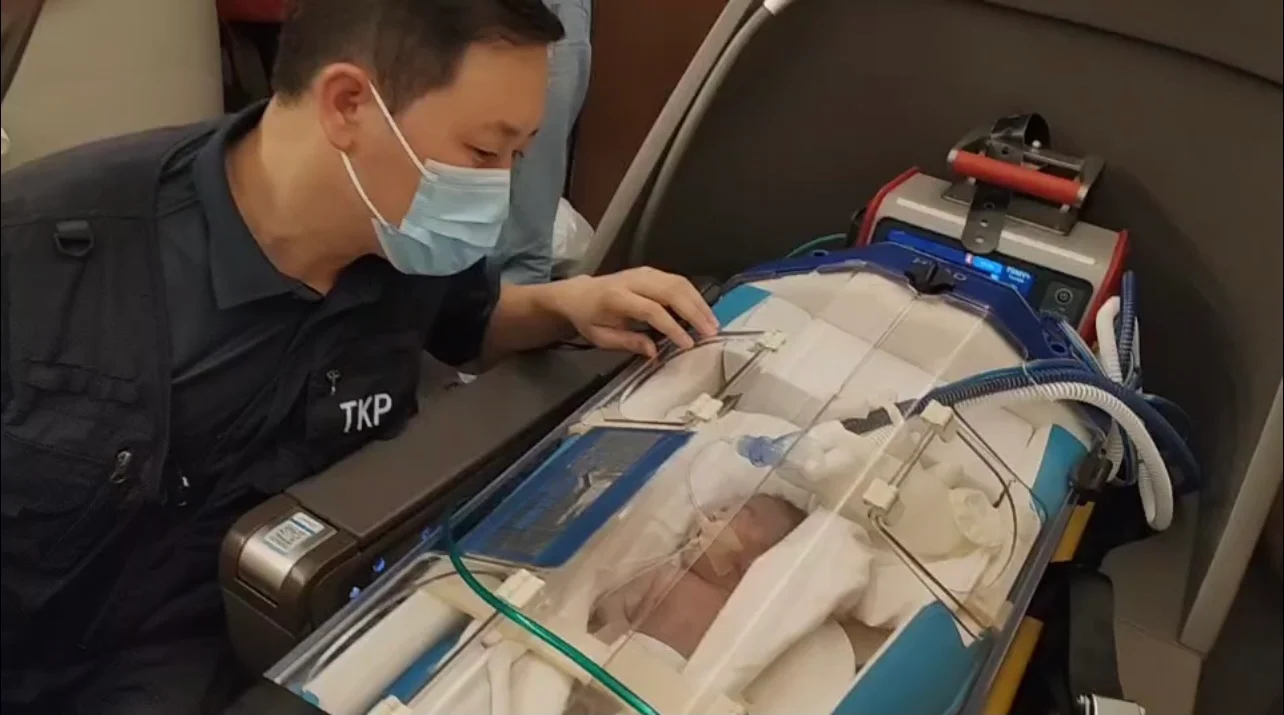
The baby is stabilized in a custom neonatal setup aboard China’s high-speed rail—ensuring minimal vibration and uninterrupted life support during the journey
Life Begins on the Edge
Born at just 27 weeks and weighing 1.1 kg, Baby Tuanzi (pseudonym) was rushed from the delivery room to the NICU. Despite advanced treatment including intubation, surfactant therapy, and infection prevention, congenital heart defects were diagnosed (PDA, ASD, PFO). After a month of intensive care, the baby was extubated, but cardiac deterioration required re-intubation and reassessment. Doctors advised transferring the infant to a specialized cardiac center in Guangzhou for further intervention.
“Jump Cloud Plan” Takes Over — A Mission Beyond Weight
Tuanzi’s family reached out to TKP, learning about its “Jump Cloud Plan” for neonatal and pediatric transport. Considering the infant’s fragile lungs, unstable cardiovascular status, and extremely small anatomy (3.0 mm ET tube), TKP designed a tailored transport strategy. Maintaining thermal support, ventilation parameters, and precise IV therapy was critical. High-speed rail was chosen to ensure a stable, vibration-controlled environment for the 500+ km journey to Guangzhou.
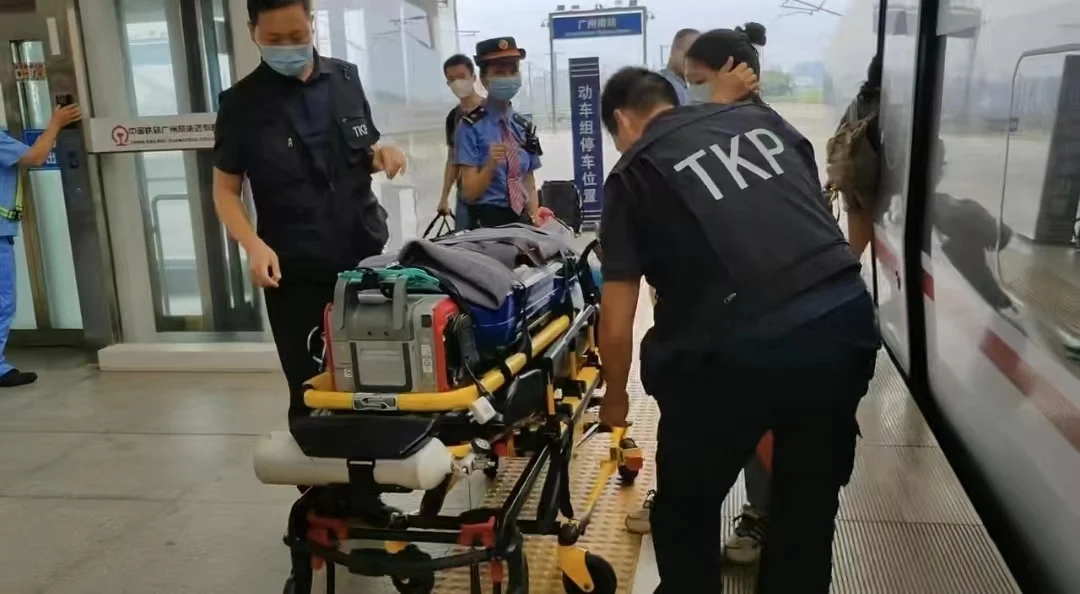
TKP medical team smoothly transfers Baby Tuanzi from the high-speed rail carriage to the ambulance, continuing critical care on the final stretch to the hospital
A Window of Life Opens
After a 5-hour continuous transfer involving ambulance-to-rail coordination, Baby Tuanzi arrived safely at Guangdong Provincial People’s Hospital. Vitals were stable on arrival: SpO₂ 95%, HR 140 bpm, BP 60/35 mmHg. The team successfully handed over sedation, respiratory, and cardiac support protocols, giving this tiny patient a timely opportunity for life-saving cardiac surgery. Gratitude goes to station staff in Guilin and Guangzhou for their assistance.
Frequently Asked Questions
Need help understanding how international medical rescue works? Browse our most common questions to learn about service coverage, response times, documentation requirements, and more. We’re here to support you every step of the way.
Q: Which countries are covered by the cross-border medical rescue service?
A: We cover major countries and regions worldwide to ensure timely rescue
Q: How can I request cross-border medical rescue?
A: Please submit an emergency rescue request through our official website or customer service.
Q: What documents are needed for medical rescue?
A: Patient ID, medical diagnosis report, and emergency contact information are required.
Q: How is the rescue service fee settled?
A: Fees can be paid via insurance claims or direct payment for the service.
Q: How quickly does the rescue response start?
A: In emergencies, rescue operations typically begin within a few hours.
Submit Your Request
Recent Posts

Tags
- Air Ambulance
- Bedside To Bedside
- Cross Border Aid
- Emergency Evacuation
- Global Medical Rescue
- How can I ensure the patient's stability while in the air?
- How do I request an air medical transport?
- How is it different from an air ambulance
- how to activate emergency aircraft service
- how to request an air ambulance
- Is air medical transport safe
- Is international transport possible
- Medical Rescue
- Medical Transport
- Patient Repatriation
- Remote Rescue
- Seamless Coordination
- Telemedicine Support
- Tourists And Expats Medical Escort
- What are the benefits of a cross-border medical transfer
- What are the different types of transfers
- What are typical use cases
- What documents do I need to prepare for a transfer?
- What does high-speed rail patient transfer stands for
- What is air ambulance
- What is air medical transport?
- What is cross-border medical transfer
- What is emergency aircraft
- what is high-speed rail patient transfer
- What is medical charter flight
- what is neonatal ICU transfer
- What is patient air transfer
- What medical equipment is available on board the aircraft
- What situations shouldn't use air medical transport?
- What types of air ambulance are there?
- What types of air ambulance exist
- What's the difference between international and domestic transfers?
- what’s the difference between air medical transport and regular ambulance?
- When is emergency air transport necessary
- Which patients require air medical transport?
- who is included in the medical team
- who needs an air ambulance