


What Types of Air Ambulance Exist: Ambulance Types Explained


What is the Air Ambulance?
Air ambulances can be the best lifeline during a medical emergency that occurs a long distance away. Did you know, though, that various types of air ambulances are tailored to various requirements? Their selection can really be the difference.
Why Different Types Matter?
Every air ambulance is not constructed similarly. Some are suitable for covering short distances and others for international transfers. Some of them are capable of landing practically anywhere, and others require airports. The best type of air medical transport depends on the condition of the patient, the geography, and the urgency of the patient.
Your Reliable Co-Ordinator of Medical Emergency Across the Border
What types of air ambulance exist? TKP Medical Assistance is one of the most active companies in this field, providing cross-border medical transport and air ambulance in China and the Greater Bay Area. Our company has been able to conduct more than 10,000 life-saving missions since its inception in 2001, and these have included air ambulance missions, commercial stretcher evacuations, and high-speed rail life-saving missions.
- We specialize in patient transportation at the ICU level, ECMO services, pediatric, and VIP medical transfers. All missions are carefully coordinated and managed with accuracy, compassion, and 24-hour coordination, and the patient will be under continuous serious care throughout the mission, both on the way to the hospital and on the way home.
- TKP Medical Assistance is headquartered in Shenzhen with six regional offices in China, with an effective network of international partners in Hong Kong, Southeast Asia, and Europe. This international capacity enables us to offer 24/7 emergency services, the coordination of borders smoothly, and the secure repatriation of patients anywhere in the world.
- It may be a cross-border stretcher evacuation, or a full-fledged air ambulance; our objective is straightforward, we are to deliver every patient home safely, with medical excellence and trusted care every mile.
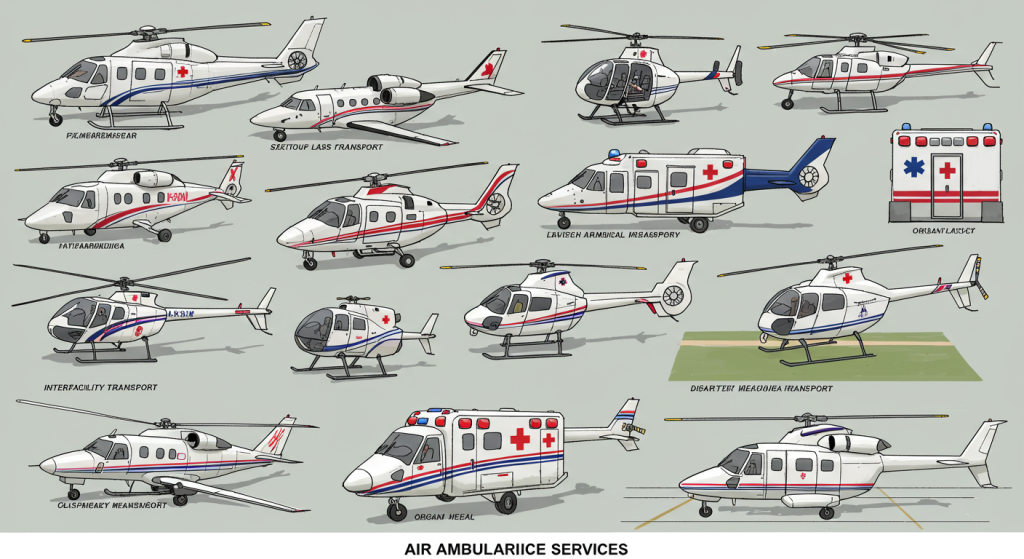
Rotary-Wing Vs Fixed-Wing: The Real Fundamentals
Air ambulances are mostly categorized into two broad classes, namely rotary-wing and fixed-wing aircraft. These are the primitive air ambulance types.
Rotary-Wing Air Ambulance (Helicopters)
- These are medical helicopters that are modified.
- They are the best at short-range and urgent operations where speed and landing agility are important.
- They can land on small spaces, such as helipads, roadsides, and rooftops, and are therefore perfect for urban rescue or rough terrain.
- They have a restricted range and depend on vertical lift instead of long runways.
- During emergencies, the long ground-based transfers to an airport can be prevented with the help of a helicopter.
This type is frequently deployed as a rescue ambulance, taking victims out of accident scenes or rural areas to hospitals in a timely fashion.
Fixed-Wing Air Ambulance (Jets/Turboprops/Airplanes)
- They are the conventional aircraft reconfigured for medical purposes.
- They are best suited to long-distance, intercity, or international transfers. Coherent Market Insights+1
- They need runways for takeoff and landing, and hence a ground transfer into and out of the airports is normally part of the flight before or after it.
- Their cabins are larger with an opportunity to have more medical staff, complete ICU equipment, and comfort. Aero Med Express+1
- They have fewer restrictions on weather and altitude, provide smoother rides, and have fewer delays. Aero Med Express+1
Practically, lots of air ambulance fleets carry both types and decide based on patient and distance conditions.
Types and Forms of Air Ambulance
In addition to the two basic ones, there are several variations. These can be hybrid or specialized:
Jet Air Ambulance
- These are dedicated jets in the form of fixed wings, and in many instances, business-jet aircraft reconfigured to become medical.
- They travel fast, long range, and can cover great distances without dropping (or with fewer stops).
- The best option when it comes to international medevac or patient repatriation over continents.
Turboprop Air Ambulance
- One of the fixed-wing aircraft with turboprop engines (propellers are made by turbines).
- They work well in medium distances, can land in shorter runways, and are economical.
- Handy in cases where jets are excessive, but rotary-wing is unable to travel distances.
Hybrid/Multi-Mode Ambulance
- Other services use helicopter operations in conjunction with fixed-wing: helicopter operations across remote locations, followed by long-haul transport on fixed-wing.
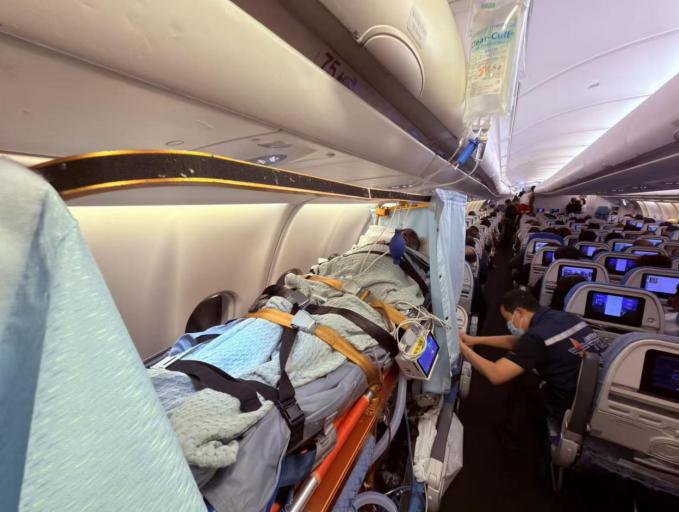
- Or when the patient is stable but requires monitoring, commercial flights may use air ambulance + medical escort.
Medical Escort Flights
- Not an air ambulance, but these are associated with the placement of a paramedic or nurse with the patient on a conventional (commercial) aircraft.
- Applicable in cases of moderate medical requirements and the absence of the necessity of ICU care.
Technical Considerations: What is Different in Each Type
Each air ambulance is built with a particular mission profile, i.e., its technical characteristics dictate where and how it can be used. The knowledge of these factors will aid in the ability to match the appropriate aircraft with the medical situation.
- The rotary-wing air ambulance (helicopter) has unparalleled landing capabilities. It can access areas of accidents or rooftops, or rural locations where runways do not exist. The range of helicopters (typically less than 300 miles) and less cabin space, however, limit the quantity of onboard medical equipment. They also cannot be used in long-range or international operations as they are very dependent on the weather.
- Contrarily, fixed-wing air ambulances – such as the turboprop and the jet airplane – are designed to be fast, elevated, and durable. They are capable of flying long distances of thousands of miles, their turbulence is better managed, and pressurized cabins are used to guarantee the comfort of patients, particularly when there is a respiratory or cardiac complication. Their bigger interiors enable ICU facilities, full of ventilators, monitors, and infusion pumps.
- Fixed-wing aircraft are also very fuel efficient, in addition to weather weather-tolerant, hence they are the best in inter-hospital and cross-border transfers. The helicopters are best in responding quickly, whereas long-haul returning patients are best served by airplanes- these constitute the workhorse of worldwide aeromedical services.
Conclusion
So, what types of air ambulance exist? Much more than most people think. The primary distinction is that of rotary-wing (helicopter) and fixed-wing (airplane/jet/turboprop). Then there are such subtypes as jets, turboprops, hybrid models, and medical escort flights. Visit TKP.
Submit Your Request
Recent Posts


Tags
- Air Ambulance
- Bedside To Bedside
- Cross Border Aid
- Emergency Evacuation
- Global Medical Rescue
- How can I ensure the patient's stability while in the air?
- How do I request an air medical transport?
- How is it different from an air ambulance
- how to activate emergency aircraft service
- how to request an air ambulance
- Is air medical transport safe
- Is international transport possible
- Medical Rescue
- Medical Transport
- Patient Repatriation
- Remote Rescue
- Seamless Coordination
- Telemedicine Support
- Tourists And Expats Medical Escort
- What are the benefits of a cross-border medical transfer
- What are the different types of transfers
- What are typical use cases
- What documents do I need to prepare for a transfer?
- What does high-speed rail patient transfer stands for
- What is air ambulance
- What is air medical transport?
- What is cross-border medical transfer
- What is emergency aircraft
- what is high-speed rail patient transfer
- What is medical charter flight
- what is neonatal ICU transfer
- What is patient air transfer
- What medical equipment is available on board the aircraft
- What situations shouldn't use air medical transport?
- What types of air ambulance are there?
- What types of air ambulance exist
- What's the difference between international and domestic transfers?
- what’s the difference between air medical transport and regular ambulance?
- When is emergency air transport necessary
- Which patients require air medical transport?
- who is included in the medical team
- who needs an air ambulance