


What Medical Equipment is Available on Board the Aircraft?


What are its Medical Provisions on Board the Aircraft?
Air travel is not dangerous but a medical emergency may occur at any moment. This is the reason why aircraft of airlines and air ambulances have medical equipment. However, what kind of medical equipment is on board the plane?
- Flying implies a distance to hospitals. When it comes to flying in the air, there are few choices. This is why planes need to be designed to accommodate not only small inconveniences but also potentially life-threatening situations. When you are flying thousands of feet in the air, time is of the essence It is that medical equipment The right medical equipment can save lives.
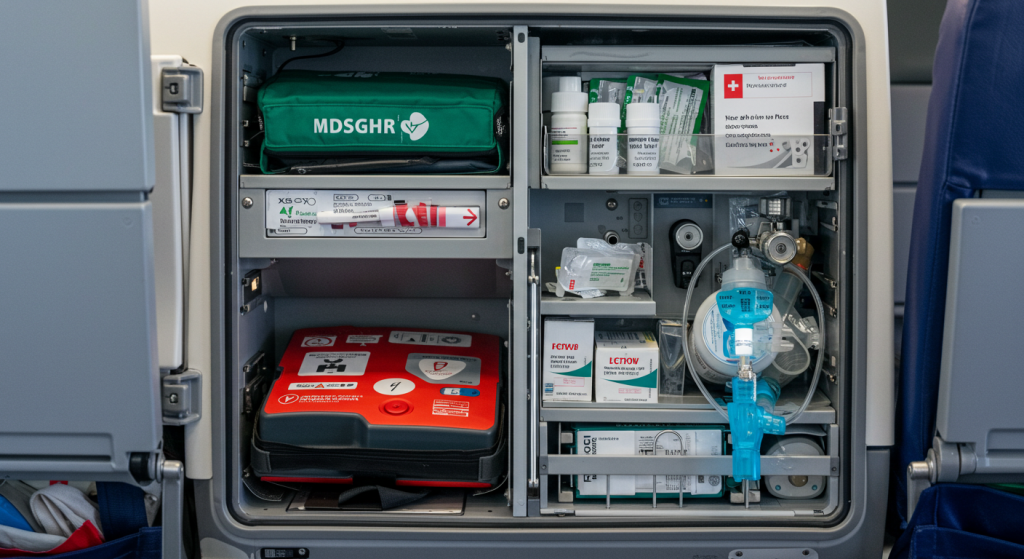
- FAA has regulations that commercial aircraft must carry first aid kits and an Emergency Medical Kit (EMK). These are necessities such as bandages, antiseptics, stethoscopes, syringes, and life-saving drugs. Appendix A to Part 121 of the 14 CFR (as cited by the Legal Information Institute) contains the list of the minimum required items that should be onboard every flight.
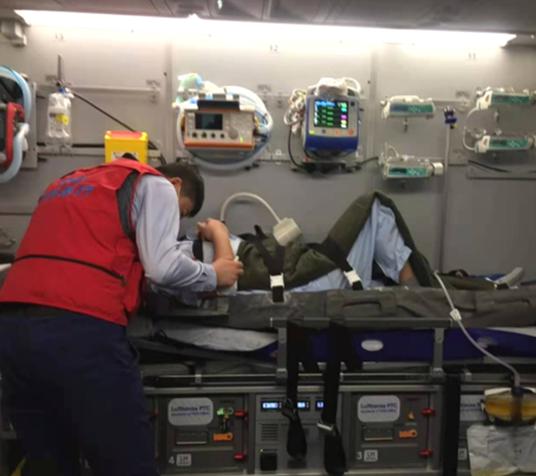
- But air ambulances put medical preparedness at a different level. These specialized planes are basically flying ICUs, with mechanical ventilators, defibrillators, oxygen systems, and monitors of patient monitors. They are intended to stabilize patients in critical conditions between hospitals or even countries.
- Onboard medical equipment comes in all types, starting with simple wound care kits to the sophisticated life support systems, such that safety and healthcare do not play second fiddle even in the skies.
How Does it Work?
What medical equipment is available on board the aircraft? Every minute is critical when there is a medical emergency in a foreign country. That is where overseas air medical aid comes in – fast, organized, and humane treatment. Our methodology guarantees that the patients are transported safely across frontiers of countries in the course of medical care and without a hitch in logistics.
- Based on the initial distress call, our coordination center considers the circumstances and provides patient specifics and decides on the most appropriate mode of transport – be it an exclusive air ambulance, a commercial flight with medical escort, or a ground ambulance connection. Upon approval, our medical staff, comprising doctors, nurses, and paramedics, will be mobilized with advanced onboard equipment, serving as a source of constant monitoring during the voyage.
- We help with cross-border authorizations, hospital organization, and bed-to-bed transfers, allowing families and other healthcare professionals to concentrate on the patient, rather than the paperwork. Each mission is designed on a case-by-case basis that complies with the international aviation and medical safety guidelines, like the IATA and FAA.
Marketplace Regulatory Framework
Knowledge Regulations would make us see what the world would look like.
FAA & U.S. Regulations
- Advisory Circuit Arctic AC 121-33B provides emergency medical equipment in commercial planes.
- An approved emergency medical kit and an automated external defibrillator (AED) are required in all U.S. air carriers flying Part 121 with 30 or more passengers on board.
- Non-U.S. airlines can adhere to ICAO, EASA rules, or national aviation authorities.
Rules: Air Ambulance and Critical Care
There are stricter standards in critical care air ambulances. They are equipped with complete life support systems, ventilators, infusion pumps, etc.
- State-level inspection sheets establish equipment lists of requirements.
- Oxygen cylinders that have a minimum liter capacity, flow meters, and backup systems are some of the guidelines.
Life Support Devices & Monitoring
There are commercial flights (particularly medical or VIP jets) that bear:
- Cardiac Monitor/ECG devices
- Pulse oximeter as a measure of oxygen saturation.
- Non-Invasive Blood Pressure Monitors.
- Defibrillator (in EMK)
- Portable Ventilator/Respiratory support (not widespread on regular commercial flights, more widespread on air ambulances)
- Oxygen system & suction unit
State-of-the-Art Air Ambulance Equipment
Critical care transport systems are furnished in air ambulance flights. Items listed below are among the devices that are present in the air ambulance medical equipment.
Ventilation, Respiratory Support
- Mechanical ventilator ( able to work in a variety of modes)
- Noninvasive positive pressure ventilation (as BiPAP, CPAP)
- Nebulizer systems
- Oxygen cylinders/onboard oxygen systems, high-liter capacity, and flow-controlled (0-25 L/min or higher) oxygen cylinders.
- Suction unit with the ability to produce a vacuum rapidly (e.g., [?] 300 mm Hg)
Airway & Intubation Tools
- Endotracheal tubes (different sizes, adult, pediatric, neonatal)
- Laryngoscope blades and sets.
- Stylets & Magill forceps
- Securing devices for tubes
Instrumentation & Diagnostic Aids
- ECG / portable cardiac monitor.
- Capnography/End-tidal CO2.
- Normal/hypothermic thermometer Temperature/thermometer
- Fetal heart tone monitor (on certain special flights)
The Way Airlines and Air Ambulances Maintain Equipment
Medical preparedness in the air is a sensitive issue that has to be monitored by stringent measures. All onboard medical equipment has to be operational, available, and accessible in case of emergencies. Operators of airlines and air ambulances adhere to international standards of preserving such life-saving tools.
- Pre-Flight Checklists: Before the flight, all first aid and emergency medical kits are thoroughly inspected to ensure that they are not expired, have proper battery life, oxygen cylinder level, and general equipment integrity.
- Scheduled Maintenance: Equipment like defibrillators, ventilators, and infusion pumps is regularly calibrated and serviced in accordance with instructions and FAA regulations.
- Seals and Logs: Medical kits are sealed with a tamper-proof seal and a maintenance log to provide an account of the opening, use, and change-outs – so that the entire history of the kit can be traced.
- Training Programs: Flight crews, nurses, and onboard medics are exposed to practical simulation training to learn how to operate the equipment and respond to emergencies.
- Augmentation: Most airlines are going out of their regulatory minimums by providing additional oxygen units, automated external defibrillators (AEDs), and telemedicine equipment to improve care.
Such an ongoing inspection, documentation, and training cycle makes sure that all medical devices are available when they are most needed.
Conclusion
Then what medical equipment is available on board the aircraft? This depends on the nature of the flight: First-aid kits, EMKs, and AEDs are required in commercial flights and are in compliance with the regulations. The intention is identical: stabilize, keep an eye on, and assist life until improved medical care can be obtained.
Submit Your Request
Recent Posts


Tags
- Air Ambulance
- Bedside To Bedside
- Cross Border Aid
- Emergency Evacuation
- Global Medical Rescue
- How can I ensure the patient's stability while in the air?
- How do I request an air medical transport?
- How is it different from an air ambulance
- how to activate emergency aircraft service
- how to request an air ambulance
- Is air medical transport safe
- Is international transport possible
- Medical Rescue
- Medical Transport
- Patient Repatriation
- Remote Rescue
- Seamless Coordination
- Telemedicine Support
- Tourists And Expats Medical Escort
- What are the benefits of a cross-border medical transfer
- What are the different types of transfers
- What are typical use cases
- What documents do I need to prepare for a transfer?
- What does high-speed rail patient transfer stands for
- What is air ambulance
- What is air medical transport?
- What is cross-border medical transfer
- What is emergency aircraft
- what is high-speed rail patient transfer
- What is medical charter flight
- what is neonatal ICU transfer
- What is patient air transfer
- What medical equipment is available on board the aircraft
- What situations shouldn't use air medical transport?
- What types of air ambulance are there?
- What types of air ambulance exist
- What's the difference between international and domestic transfers?
- what’s the difference between air medical transport and regular ambulance?
- When is emergency air transport necessary
- Which patients require air medical transport?
- who is included in the medical team
- who needs an air ambulance