


What Air Ambulance Flight Stretcher Features Matter in Emergencies?


Air ambulance flight stretcher technology can decide outcomes in the air – and at TKP Medical Assistance, we design for those decisive moments.

What Features Matter When Every Minute Counts
When a patient is unstable, small design choices become big clinical wins. An Air ambulance flight stretcher must lock in place fast, absorb vibration, and give clinicians clear access from head to toe. It also needs to integrate with aircraft power, oxygen, and monitoring without fuss. We build around those realities, not around lab conditions.
• Rigid Locking & Quick-Mount Rails: Secure, one-handed locking reduces load time and prevents micro-shifts during turbulence. Faster fixation means earlier medication, earlier ventilation, and fewer in-flight alarms.
• Vibration & Shock Management: Multi-layer damping and restrained flex help protect head injuries and post-op patients. Less vibration reduces nausea, pain spikes, and monitor artifacts.
• Full 360° Clinical Access: Low-profile side frames and adjustable backrests allow airway work, IV management, and chest access without repositioning. This minimizes risk during in-flight deterioration.
• Weight Capacity With Margin: Bariatric readiness isn’t optional. Higher safe working loads with clear center-of-gravity marking cut lifting risk and prevent last-minute aircraft swaps.
• Integrated Power & Oxygen Ports: Clean cable and hose routing keeps lines visible and secure. Plug-and-play power supports pumps, ventilators, and monitors through takeoff and landing.
• Compatibility Across Cabins: An Air ambulance flight stretcher must transfer seamlessly from ground ambulance to fixed-wing or commercial cabin. Cross-platform fittings prevent costly delays.
Behind each feature is a simple goal: shorten the timeline from door to care, and keep the patient stable from the first lift to the final handover.
How TKP Builds Reliability
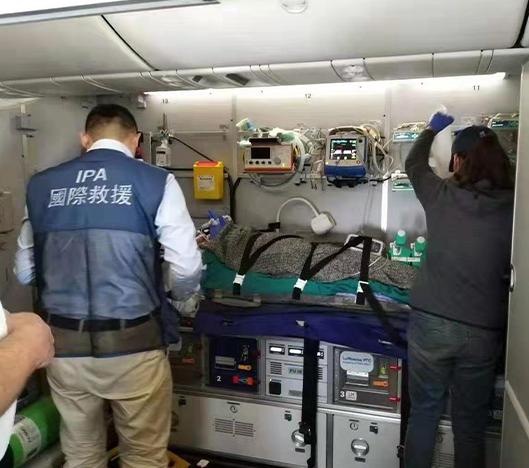
As a manufacturer working hand-in-hand with our operations teams, we optimize the full journey – not just the stretcher. With airline approval, we help arrange dedicated stretcher compartments on international or domestic commercial flights for bedridden patients. Medical escorts stay with the patient end to end. This is a cost-effective route for stable cases that still need continuous oversight.
For urgent or complex cases, our air ambulance services provide a controlled clinical environment with full onboard support. We also design for transfer reality: high-speed rail and ground ambulances often bookend the flight. Our engineering emphasis is continuity – so the Air ambulance flight stretcher docks, undocks, and re-fixes quickly across vehicles without new risks at each handover.
✅ Smart Route Planning For Remote Access
Patients don’t always start near big hubs. Our transfer route map prioritizes reach and speed:
• Dynamic Scheduling: We tailor routes to patient condition and urgency, cutting time on scene and in the air.
• Global Coverage: Domestic and international paths connect remote or underserved locations to top centers.
• Airport Flexibility: We work with airports that have minimal infrastructure, enabling faster lifts from difficult geographies.
• Optimized Legs: We reduce flight time and turbulence exposure where possible, improving patient comfort and safety.
• Tight Coordination: Hospitals and embassies are looped in early, smoothing clearances and bed availability.
An operations team monitors flights in real time and can adjust routes mid-mission. That means the stretcher, the aircraft, and the plan all work as one system focused on safe arrival.
Proof In Numbers, Built For Today‘s Missions
TKP Medical Assistance has 24+ years of experience and has completed over 10,000 missions across emergency and non-emergency profiles. Those numbers matter because they feed design feedback. Every mission adds data points to improve clamp tolerances, mattress foams, and cable management. We learn what breaks, what bends, and what simply gets in the way at 30,000 feet.
In practice, that experience shows up in small but critical details: smooth edges that protect nursing hands in tight cabins; mattress zones that relieve pressure during long transfers; and color-coded touch points that speed training for visiting teams. Our Air ambulance flight stretcher systems are built to be intuitive under stress. If a clinician can find the release with gloved fingers in low light, we have done our job.
Not every patient needs a chartered aircraft. For stable, cross-border transports, our commercial stretcher solution – with airline approval and full medical escort – offers strong value. For post-stabilization critical care or time-sensitive evacuations, our dedicated air ambulance platform delivers ICU-level readiness. In both cases, the stretcher is the constant: it anchors the care plan from bed to aircraft to bed again.
Where are the pain points today? Operators face rising patient weights, tighter airport windows, variable cabin layouts, and staffing pressure. We address these with higher load ratings, modular mount kits, and training that focuses on the first 10 minutes – the most error-prone window. By cutting changeover steps and improving visibility of cables and lines, we reduce avoidable alarms and delays.
Call To Action
If you’re planning new routes, upgrading fleets, or standardizing equipment, talk to us. TKP Medical Assistance can help audit your current pathway, map compatibility across your vehicles, and recommend an Air ambulance flight stretcher configuration that speeds transfers while protecting your teams. Let’s design for the moments that matter – so your next mission is faster, safer, and simpler.
Submit Your Request
Recent Posts


Tags
- Air Ambulance
- Bedside To Bedside
- Cross Border Aid
- Emergency Evacuation
- Global Medical Rescue
- How can I ensure the patient's stability while in the air?
- How do I request an air medical transport?
- How is it different from an air ambulance
- how to activate emergency aircraft service
- how to request an air ambulance
- Is air medical transport safe
- Is international transport possible
- Medical Rescue
- Medical Transport
- Patient Repatriation
- Remote Rescue
- Seamless Coordination
- Telemedicine Support
- Tourists And Expats Medical Escort
- What are the benefits of a cross-border medical transfer
- What are the different types of transfers
- What are typical use cases
- What documents do I need to prepare for a transfer?
- What does high-speed rail patient transfer stands for
- What is air ambulance
- What is air medical transport?
- What is cross-border medical transfer
- What is emergency aircraft
- what is high-speed rail patient transfer
- What is medical charter flight
- what is neonatal ICU transfer
- What is patient air transfer
- What medical equipment is available on board the aircraft
- What situations shouldn't use air medical transport?
- What types of air ambulance are there?
- What types of air ambulance exist
- What's the difference between international and domestic transfers?
- what’s the difference between air medical transport and regular ambulance?
- When is emergency air transport necessary
- Which patients require air medical transport?
- who is included in the medical team
- who needs an air ambulance