


How Commercial Airline Flight Stretcher Teams Handle Medical Risks


Commercial Airline Flight Stretcher transport is often seen as simple, but the real challenge lies in how medical risks are controlled from takeoff to landing. When a patient is confined to a stretcher at 30,000 feet, even small issues can escalate quickly. How do teams keep every detail stable in such a limited space? And what decisions protect a patient when complications appear mid-flight? This article reveals the unseen work behind safe stretcher transfers – and why expertise matters.
How TKP Handles Risk Before Wheels-Up
Families, hospitals, and insurers face the same pain points: confusing airline rules, slow approvals, hidden costs, and fear of in-flight complications. As a manufacturer-operator, TKP Medical Assistance simplifies each step and sets a predictable safety baseline for every Commercial Airline Flight Stretcher mission.
- Triage And Eligibility
We begin with a short, structured triage. It confirms the patient is stable enough for a Commercial Airline Flight Stretcher instead of an air ambulance. Our physicians review recent labs, imaging, and bedside notes. If red flags appear – uncontrolled bleeding, rising oxygen needs, unstable cardiac rhythm – we pause the plan and recommend a higher-acuity solution.
• Clear go/no-go criteria
• Physician-to-physician handoff with the sending hospital
• Transparent explanation of stretcher vs. air ambulance trade-offs
- Airline Approval And Cabin Setup
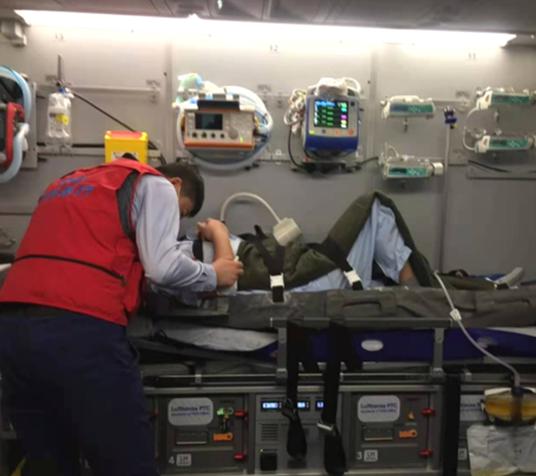
Every stretcher case needs airline approval. We secure it and configure a dedicated stretcher compartment (patient transport compartment) with privacy screens, power supply, and medical mounts. We pre-load equipment to avoid gate delays and build redundancy for critical items.
• Dedicated stretcher zone with anchored bed and monitoring
• Power management for infusion pumps, ventilators, and monitors
• Spare oxygen and backup batteries for contingencies
- Route Planning That Reduces Risk
Time in transit drives risk. Our route team selects flights and alternates that shorten exposure, avoid weather bottlenecks, and support quick medical escalation if needed. The network covers domestic and international points, including airports with minimal infrastructure, which helps us reach remote areas faster.
• Dynamic scheduling aligned to patient condition and urgency
• Optimized routing to cut flight time and handoff delays
• Coordination with hospitals, insurers, and embassies for clearances
Managing Medical Risks In The Air
Inside the stretcher compartment, our medical escorts run a calm, repeatable protocol. Most patients need stable vital signs, reliable oxygenation, and pain control. Some need more: sedation, non-invasive ventilation, or blood gas trending during long sectors. We bring the capability – then keep it simple and stable.
- Continuous Monitoring, Not Constant Alarms
We set individualized targets for heart rate, blood pressure, oxygen saturation, and end-tidal CO₂ when indicated. Alarm thresholds are tuned to the patient, so our team responds early without creating noise fatigue.
- Oxygenation And Ventilation
We plan oxygen down to minutes, with reserves. If the patient is on CPAP/BiPAP or a transport ventilator, we use cabin-pressure-aware settings and document the step-wise plan for ascent and descent – two phases where risk spikes.
- Medication Safety
Sedation eases discomfort but can mask trouble. Our approach is light, titratable, and reversible. Infusions are labeled, double-checked, and carried in duplicate. Anti-emetics and analgesia are prepared in advance to avoid in-flight compounding.
- Blood Gas And Status Checks
On long-haul flights or complex neurologic cases, our team can perform point-of-care checks during designated intervals. The goal is simple: confirm the physiology we expect is the physiology we have.
• Stabilize early, then make small adjustments
• Communicate changes to the receiving hospital in real time
• Document every step for insurer and clinical continuity
- When Air Ambulance Is Wiser
Not every patient should fly on a Commercial Airline Flight Stretcher. If the risk profile exceeds cabin capabilities – fresh post-op, high vasopressor needs, unstable airway – we switch to a dedicated air ambulance. Safety outranks convenience.
Proof In Practice – And A Clear Path For Your Next Case
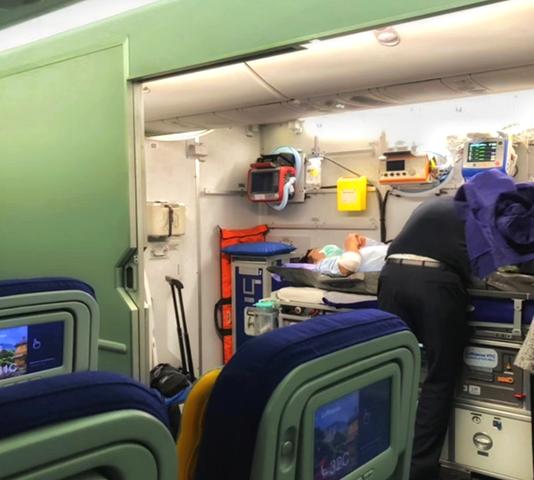
On February 14, 2019, our team coordinated a stretcher transfer from Milan to Eastbourne for a patient with traumatic brain injury. The itinerary crossed multiple jurisdictions and languages. We set up a 10-hour transfer ICU at Paris Charles de Gaulle for real-time blood gas monitoring and vital-sign adjustment, then completed the journey with continuous updates to the receiving team. The patient traveled in a secured stretcher compartment with oxygenation and light sedation to minimize discomfort. Each handoff was pre-briefed; each risk had a plan.
This is how we operate every day. With 24+ years in aero-medical evacuation and 10,000+ successful missions, TKP Medical Assistance blends manufacturing-grade reliability with bedside judgment. Our integrated solutions mean you do not need to assemble vendors yourself:
• Commercial Airline Flight Stretcher with airline approval and full escort
• Air ambulance for high-acuity or time-critical scenarios
• Integrated rail and ground ambulance to close the “last mile”
• Flight monitoring and route adjustments in real time
For families, this reduces anxiety and surprise costs. For hospitals and case managers, it creates a single pathway from bed to bed. For insurers, it brings documentation, predictable pricing, and defensible clinical decisions. Most of all, it keeps the patient safe, comfortable, and moving toward definitive care.
What You Can Expect Next
- A rapid medical review to confirm stretcher suitability.
- A clear itinerary with equipment, medications, and contingency plans.
- Dedicated escorts who manage the cabin, the devices, and the details.
Call To Action
If you are planning a Commercial Airline Flight Stretcher transfer – or deciding whether stretcher or air ambulance is safer – talk to TKP Medical Assistance today. We will assess the case, secure airline approval, and build a route that minimizes risk while controlling cost. Your patient’s safest journey starts with one conversation.
Submit Your Request
Recent Posts


Tags
- Air Ambulance
- Bedside To Bedside
- Cross Border Aid
- Emergency Evacuation
- Global Medical Rescue
- How can I ensure the patient's stability while in the air?
- How do I request an air medical transport?
- How is it different from an air ambulance
- how to activate emergency aircraft service
- how to request an air ambulance
- Is air medical transport safe
- Is international transport possible
- Medical Rescue
- Medical Transport
- Patient Repatriation
- Remote Rescue
- Seamless Coordination
- Telemedicine Support
- Tourists And Expats Medical Escort
- What are the benefits of a cross-border medical transfer
- What are the different types of transfers
- What are typical use cases
- What documents do I need to prepare for a transfer?
- What does high-speed rail patient transfer stands for
- What is air ambulance
- What is air medical transport?
- What is cross-border medical transfer
- What is emergency aircraft
- what is high-speed rail patient transfer
- What is medical charter flight
- what is neonatal ICU transfer
- What is patient air transfer
- What medical equipment is available on board the aircraft
- What situations shouldn't use air medical transport?
- What types of air ambulance are there?
- What types of air ambulance exist
- What's the difference between international and domestic transfers?
- what’s the difference between air medical transport and regular ambulance?
- When is emergency air transport necessary
- Which patients require air medical transport?
- who is included in the medical team
- who needs an air ambulance