


How Flight Stretcher For International Patient Transfer Solves Long Flights?


Flight Stretcher For International Patient Transfer is often the safest way to move a fragile patient across long distances on commercial flights, without paying for a full air ambulance.
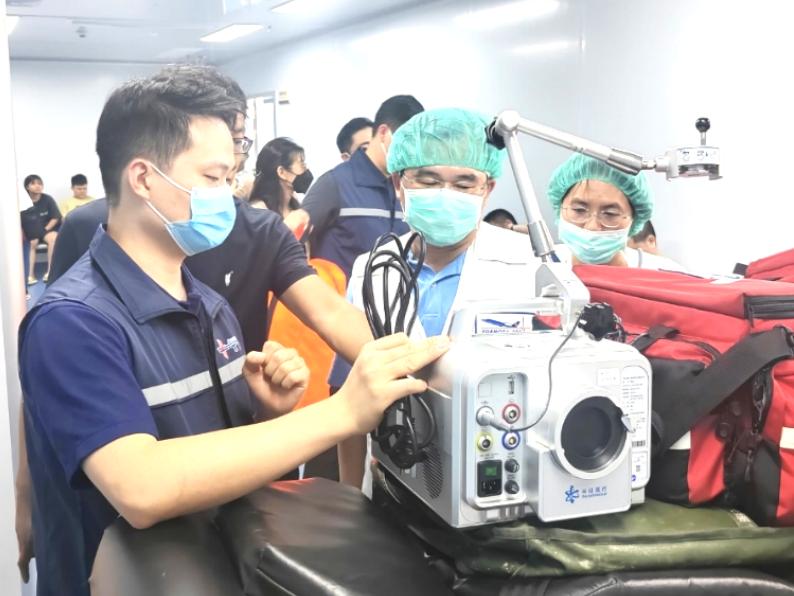
At TKP Medical Assistance, we receive calls like this: a patient is medically stable after surgery, but still needs to lie flat, use a ventilator, or has a tracheostomy. The family wants them home. The treating doctor wants continuity of care. Yet there is one big problem: the flight is 8 – 11 hours long.
Long flights are not just “sitting in a plane for a long time.” For patients, they can mean dry air, pain, secretions, unstable vital signs – and for families, huge stress and high costs. In this article, we explain how a Flight Stretcher For International Patient Transfer helps solve these long-flight challenges, and how TKP makes it safe, efficient, and more affordable.
Why Long Flights are So Hard for Patients
On a normal commercial flight, the cabin is designed for healthy travelers, not for patients with complex needs. For someone with a recent brain surgery, a tracheostomy, or limited mobility, a long-haul flight can quickly become dangerous.
Cabin air humidity on long flights is often only 10 – 20%. For a patient with a tracheostomy, there is no nose or mouth to warm and humidify the air. Dry, cold air goes straight into the airway. This can lead to:
• Thick secretions and crusts that may block the tube
• Reduced mucus clearance and higher risk of lung infection
• Airway spasms and severe coughing, triggered by cold, dry air
At the same time, staying in one position for more than 8 hours increases the risk of pressure injuries, pain, and blood clots. For families, the financial pressure is also real. A full medical air ambulance can cost several times more than a commercial option. In many cases, using a Flight Stretcher For International Patient Transfer on a scheduled airline can reduce costs by over 70%, while still keeping medical safety as the first priority.
This is the pain point we see again and again:
- The patient is stable, but cannot sit in a normal seat.
- The family needs a safe solution, but cannot accept extreme costs.
- The hospital wants a professional team to take full medical responsibility door to door.
This is exactly the gap that TKP’s flight stretcher service is designed to fill.
How TKP Uses Flight Stretcher for International Patient Transfer
When TKP Medical Assistance receives a call, our team does not start with tickets. We start with clinical safety.
Pre-Flight Assessment and Bed-To-Bed Planning
First, our on-duty medical officer speaks directly with the treating ICU or ward doctor. We review:
•Diagnosis, surgery history, and current vital signs
•Airway status, including tracheostomy, ventilator needs, oxygen level
•Medications, infection control, and mobility limitations
If the patient is suitable for a Flight Stretcher For International Patient Transfer, we design a bed-to-bed plan. That means:
- Ground ambulance from the sending hospital to the airport
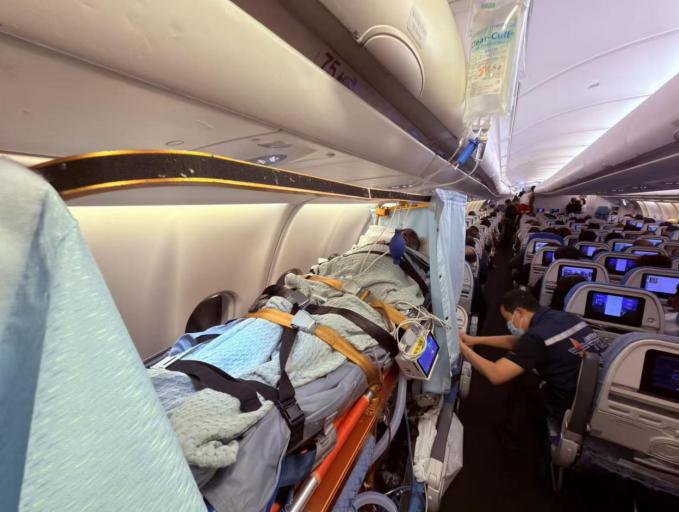
- Stretcher installation and cabin layout with the airline
- In-flight medical monitoring and airway management
- Ground ambulance and handover at the receiving hospital
From the first phone call to the final handover, there is no break in medical supervision.
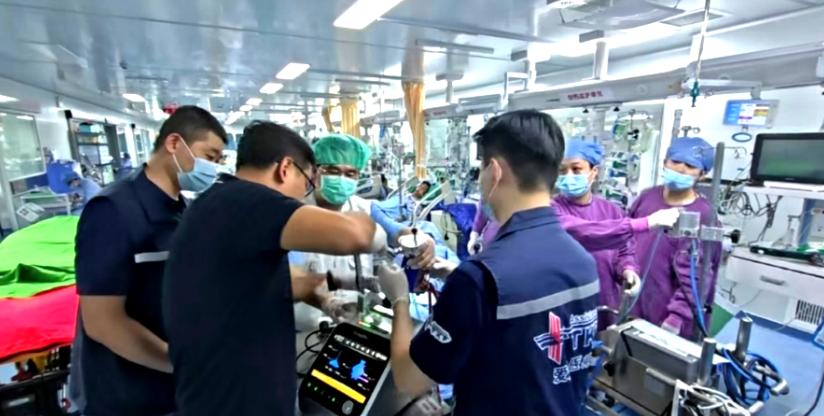
In-Flight Airway and Comfort Management
For a long-haul stretcher case, especially with a tracheostomy, airway care is the core challenge. TKP does not rely on “basic equipment only.” We build a multi-layer safety system around the patient:
Active humidification with the ventilator or breathing circuit
We use external humidification combined with intermittent nebulization to keep the airway warm and moist. This helps prevent thick secretions and protects the airway lining during the entire 8 – 11 hour flight.
High-frequency suction device with backup power
A battery-powered suction unit allows frequent, gentle suctioning without relying only on cabin power. Backup batteries ensure that no turbulence, delay, or power issue can stop critical airway care.
Special tracheostomy interfaces and temperature management
We use dedicated tracheostomy connectors that work with the humidification system. Our team constantly checks the moisture and temperature of the inhaled air, adjusting settings based on patient comfort and clinical signs.
ICU doctor + transport nurse dual-team model
On TKP missions, an experienced ICU physician and a trained transport nurse travel together. They watch:
- Respiratory rate and oxygen saturation
- Humidifier performance and condensation in the tubing
- Signs of airway obstruction, pain, or distress
This dual-team model allows one professional to focus on monitoring while the other handles interventions, documentation, and communication with the cabin crew.
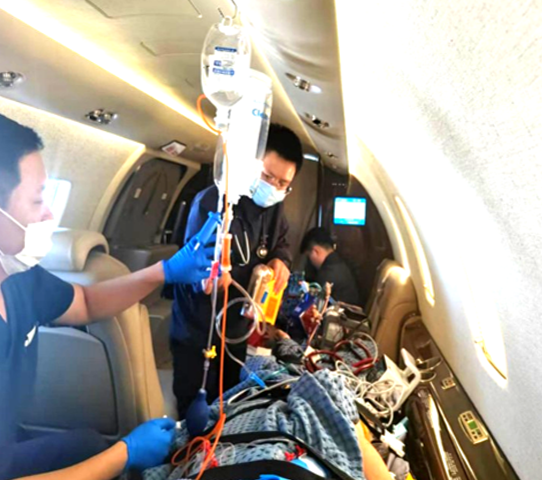
In one recent case, a patient with a subarachnoid hemorrhage and tracheostomy was transferred from Australia back to Hong Kong on a long-haul commercial flight. Thanks to this structured approach, we completed almost 11 hours of intercontinental transfer with stable airway function and continuous medical care, from ICU bed to receiving ward – truly “bed-to-bed”.
For us at TKP, every Flight Stretcher For International Patient Transfer is not just a transport. It is a moving ICU environment that we rebuild inside a commercial aircraft.
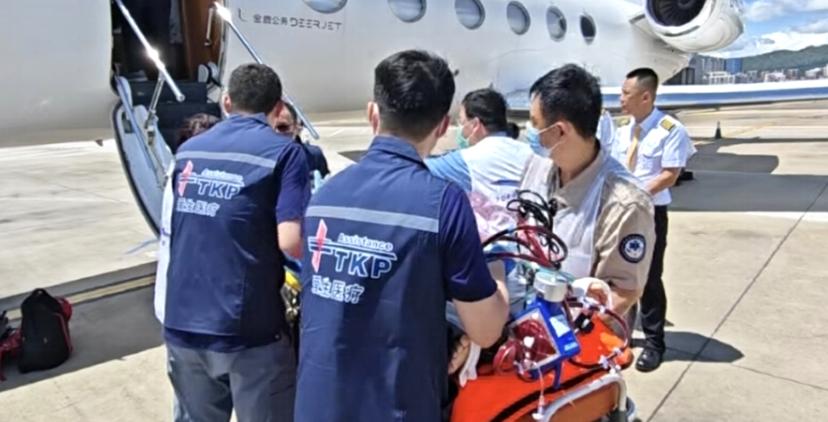
When Flight Stretcher for International Patient Transfer Is the Right Choice
A Flight Stretcher For International Patient Transfer is not for every case, but it is ideal when:
•The patient is medically stable, but must lie flat
•Ongoing oxygen, airway care, or monitoring is needed
•Family wants to balance safety and cost
•Hospitals or insurers require a professional, documented solution
For airlines, insurers, and hospitals, partnering with TKP Medical Assistance brings clear value:
- One team handles assessment, planning, in-flight care, and final handover
- Costs are controlled compared to a full air ambulance
- Documentation and communication follow international medical standards
TKP Medical Assistance was founded in 2001 and is part of the National Health Commission’s international emergency rescue network. Over the years, our network has grown from serving the Guangdong – Hong Kong corridor to covering global medical transfers, working closely with airlines, general aviation, and major insurers.
Whether you are:
•Coordinating an international discharge
•Managing medical costs as an insurer
•Trying to get a loved one safely home
A Flight Stretcher For International Patient Transfer with TKP Medical Assistance can close the gap.
��� Reach out to TKP Medical Assistance now for a clear assessment and a customized stretcher flight plan. Let us turn a long, stressful journey into a controlled, medically supervised transfer.
Submit Your Request
Recent Posts
Tags
- Air Ambulance
- Bedside To Bedside
- Cross Border Aid
- Emergency Evacuation
- Global Medical Rescue
- How can I ensure the patient's stability while in the air?
- How do I request an air medical transport?
- How is it different from an air ambulance
- how to activate emergency aircraft service
- how to request an air ambulance
- Is air medical transport safe
- Is international transport possible
- Medical Rescue
- Medical Transport
- Patient Repatriation
- Remote Rescue
- Seamless Coordination
- Telemedicine Support
- Tourists And Expats Medical Escort
- What are the benefits of a cross-border medical transfer
- What are the different types of transfers
- What are typical use cases
- What documents do I need to prepare for a transfer?
- What does high-speed rail patient transfer stands for
- What is air ambulance
- What is air medical transport?
- What is cross-border medical transfer
- What is emergency aircraft
- what is high-speed rail patient transfer
- What is medical charter flight
- what is neonatal ICU transfer
- What is patient air transfer
- What medical equipment is available on board the aircraft
- What situations shouldn't use air medical transport?
- What types of air ambulance are there?
- What types of air ambulance exist
- What's the difference between international and domestic transfers?
- what’s the difference between air medical transport and regular ambulance?
- When is emergency air transport necessary
- Which patients require air medical transport?
- who is included in the medical team
- who needs an air ambulance