


What are the Types of Medical Aircraft? 2026 Practical Guide


The choice of aircraft can shorten time to definitive care and determine whether a cross-border transfer proceeds smoothly. Medical Aircraft Types influence speed, range, cabin configuration, and access to hospitals, so the selection is both a clinical decision and a logistical one. This guide explains the main categories – helicopters, turboprops, jets, commercial flight and emerging VTOL platforms – when each is appropriate, the operational and regulatory realities of international missions, and how TKP Medical Assistance delivers bedside-to-bedside continuity across China and the Greater Bay Area.
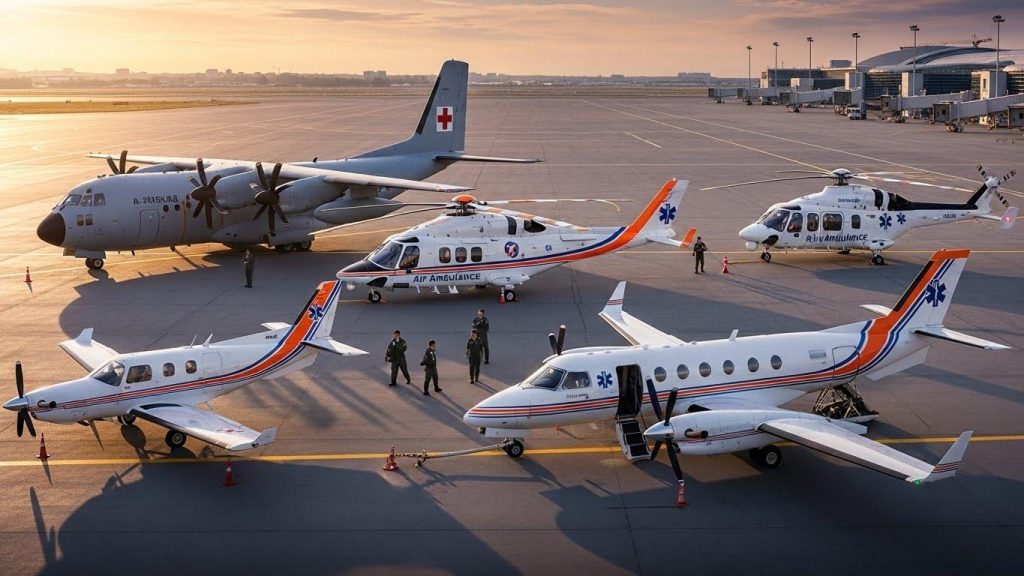
Why Aircraft Selection Matters
Every minute counts in medical transport, but speed is only part of the equation. Range, ceiling performance, cabin footprint, oxygen duration, power availability, and direct access to city centers or hospital helipads all drive mission success. Selecting an aircraft that fits patient acuity, route geography, and permitting realities prevents delays, limits clinical compromise, and keeps costs predictable.
Typical performance ranges help orient planning:
• Helicopters: cruise roughly 220–260 km/h with practical reach of 200–600 km. Best fit for short urban or regional links. Best for short urban or regional links.
• Turboprops: cruise around 450–600 km/h, range about 1,500–2,500 km. Efficient for mid-distance missions and secondary airports.
• Jets: cruise near 700–850 km/h, range 3,000–6,000 km. Ideal for long-haul, cross-border transfers.
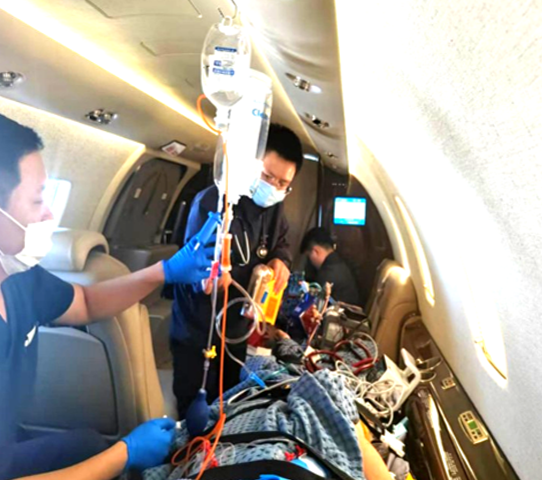
Most medical flights carry a two-clinician team (physician and/or critical care nurse). Standard kit includes ventilators, multi-parameter monitors, infusion pumps, suction, and oxygen sized for 4–8 hours, with extensions when case complexity demands it. Cross-border missions introduce layers of approvals – overflight and landing permits, immigration, customs, and receiving hospital acceptance – that must be sequenced and synchronized to keep the patient moving.
Rotary–Wing Solutions: Helicopters for Rapid Access
When distance is short and time is unforgiving, helicopters deliver patients directly from scene or rooftop to definitive care. They land close to hospitals, avoid road congestion, and do not require runways – advantages that are decisive for trauma, stroke, STEMI, and certain obstetric emergencies.
- Strengths:
• Direct hospital helipad access and urban landing options.
• Fast wheels-up: often 10–20 minutes from well-prepared bases.
• Optimal for intra-city and sub-400 km regional hops.
- Limitations:
• Tight cabin volume can constrain advanced setups such as ECMO.
• Weather, night operations, and instrument flight depend on local rules and aircraft capability.
• Cross-border helicopter permits and customs tend to be stricter than fixed-wing alternatives.
In the Greater Bay Area, helicopters can bridge city gaps quickly. For most international transfers, however, fixed-wing Medical Aircraft Types offer smoother cross-border continuity and fewer regulatory hurdles.
Fixed–Wing Solutions: Turboprops and Jets for Distance and Comfort
Fixed-wing platforms carry the bulk of intercity and international medical evacuations. Turboprops shine on regional routes thanks to lower operating costs and short-runway performance. Jets bring speed, cabin volume, and altitude comfort – critical on long legs and time-sensitive itineraries.
- Clinical and operational fit:
• Turboprops: stable cabin environments for ventilated patients, neonatal incubators, and isolation cases; strong value on 800–1,800 km sectors and access to secondary airports closer to referring or receiving hospitals.
• Jets: generous cabin space for full ICU configurations, robust pressurization for altitude-sensitive conditions, and reliable performance on 2,000–5,000 km missions or longer.

International fixed-wing activations usually require 90–180 minutes to align permits, slots, and customs. Typical layouts support one stretcher plus one or two family escorts; specialized equipment can be added after weight-and-balance checks and power/oxygen planning. For severe cases, flight physicians tailor the cabin with redundancy – backup ventilators, extended oxygen, drug infusions, and invasive monitoring – to maintain ICU-level care throughout.
Commercial Flight Medical Escort: Cost-Controlled Transfers for Stable Patients
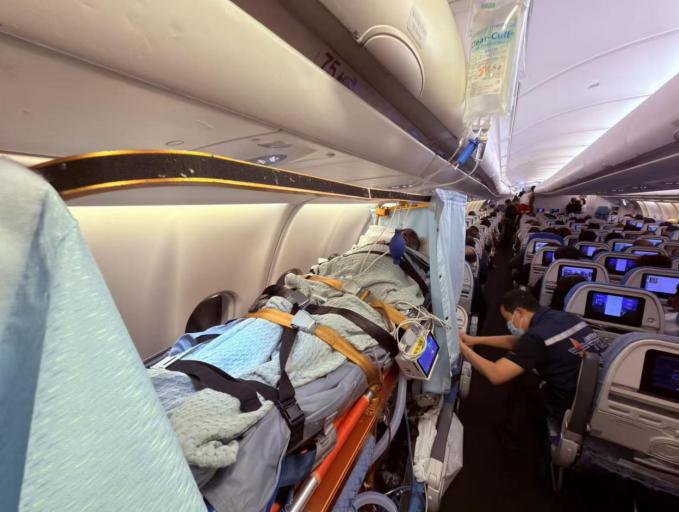
For patients clinically cleared to travel in an airline cabin, a medical escort on a scheduled flight can deliver safe continuity at a fraction of the cost of a dedicated air ambulance. TKP Medical Assistance assigns physician or nurse escorts to manage medications, mobility, airline-approved oxygen, and continuous observation, leveraging frequent departures across domestic and international networks.
- Strengths:
• Significant cost savings compared with chartered air ambulance jets or turboprops.
• Broad route availability and predictable timetables.
• Suitable for patients who tolerate cabin pressure and can remain seated during takeoff and landing.
- Limitations:
• Airline medical clearance standards vary, sometimes extending lead time.
• Stretcher carriage is limited or unavailable on many carriers; oxygen follows airline policy.
• Interventions and equipment are constrained by commercial cabin protocols.
Across Hong Kong, Shenzhen, Guangzhou, Zhuhai, and Macau – and worldwide – acceptance hinges on airline criteria, ground wheelchair/aisle-chair support, and airport medical services. TKP secures approvals, assigns the right escort level, and synchronizes ground ambulances to preserve bed-to-bed continuity. For time-critical or ICU-level scenarios, a dedicated air ambulance remains the primary pathway.
Emerging Platforms: VTOL and Medical Drones in 2026
Electric VTOL aircraft and medical drones are crossing from experimental pilots to early commercial operations. VTOL designs aim for helipad-like access with lower noise and emissions, yet certification across Asia-Pacific is still catching up. First deployments will likely occur in regulated city corridors with designated vertiports. In the near term, VTOL will supplement short-range city transfers where infrastructure supports them.
Medical drones already add value by moving blood products, lab samples, and small medical equipment across congested districts. While they do not carry patients, they reduce time-to-care by speeding diagnostics and therapy availability and integrating deeper into hospital logistics.
- Strengths:
• VTOL: point-to-point urban access with reduced acoustic footprint and emissions; potential cost advantages on short hops.
• Drones: swift delivery of small critical cargo; automated routing shortens laboratory and transfusion turnaround times.
- Limitations:
• VTOL: lower payload and range relative to conventional helicopters; certification and operational approvals remain constrained. Reliance on vertiports, charging infrastructure, and integration with air traffic control; weather and instrument flight rules compress schedules.
• Drones: small payloads only, strict BVLOS/airspace rules, and complex cross-border customs considerations.
As corridors expand in the Greater Bay Area and globally, VTOL and drones will enhance urban care logistics. Cross-border patient transport, however, will continue to rely on certified helicopters and fixed-wing Medical Aircraft Types until regulation and infrastructure mature.
Choosing the Right Medical Aircraft for Your Case
TKP Medical Assistance applies structured triage before activation to align platform choice with risk and reach:
• Clinical severity: airway stability, ventilation needs, vasoactive support, ECMO, neonatal care, isolation precautions.
• Geography: rooftop-to-rooftop urban transfers, regional intercity routes, or international legs.
• Access and permits: hospital helipads, runway length, overflight clearances, customs/immigration timing.
• Weather and night rules: instrument flight capability, alternates, diversions.
• Cabin: electrical load, O2 endurance, stretcher footprint, device bay clearance.
• Receiving: bed confirmed, specialist team on standby, language services coordinated.
❓ Pain points: permits, ICU capacity, opaque pricing, fragmented comms.
✅ Mitigation: centralized ops with parallel workflows, multilingual support, and clear cost inputs – distance, platform, crew level, permits, ground ambulances, oxygen/fuel.
TKP Medical Assistance: Bedside–to–Bedside Assurance
TKP Medical Assistance integrates aviation, clinical governance, and border formalities into one accountable pathway. Bilingual coordinators manage consents, medical summaries, and hospital acceptance. Flight physicians configure cabins for ventilated ICU transports, neonatal incubators with thermal control, or isolation for infectious conditions. Partner operators meet international accreditation standards, aligning safety, maintenance, and training to best-practice frameworks.
What this means for you:
• A single point of contact from bedside to bedside across China and the Greater Bay Area.
• Mode selection aligned to clinical risk and time-to-care, using proven Medical Aircraft Types.
• Parallel permit and immigration processing to compress activation timelines.
• Transparent planning: route, alternates, oxygen strategy, fuel, and ground links at both ends.
Call to Action
If you need urgent guidance on Medical Aircraft Types for a current case – or want to pre-plan cross-border coverage for your organization – contact TKP Medical Assistance now. Our 24/7 team will assess the clinical scenario, recommend the most appropriate platform, and initiate coordinated steps for a safe, timely transfer.
Submit Your Request
Recent Posts

Tags
- Air Ambulance
- Bedside To Bedside
- Cross Border Aid
- Emergency Evacuation
- Global Medical Rescue
- How can I ensure the patient's stability while in the air?
- How do I request an air medical transport?
- How is it different from an air ambulance
- how to activate emergency aircraft service
- how to request an air ambulance
- Is air medical transport safe
- Is international transport possible
- Medical Rescue
- Medical Transport
- Patient Repatriation
- Remote Rescue
- Seamless Coordination
- Telemedicine Support
- Tourists And Expats Medical Escort
- What are the benefits of a cross-border medical transfer
- What are the different types of transfers
- What are typical use cases
- What documents do I need to prepare for a transfer?
- What does high-speed rail patient transfer stands for
- What is air ambulance
- What is air medical transport?
- What is cross-border medical transfer
- What is emergency aircraft
- what is high-speed rail patient transfer
- What is medical charter flight
- what is neonatal ICU transfer
- What is patient air transfer
- What medical equipment is available on board the aircraft
- What situations shouldn't use air medical transport?
- What types of air ambulance are there?
- What types of air ambulance exist
- What's the difference between international and domestic transfers?
- what’s the difference between air medical transport and regular ambulance?
- When is emergency air transport necessary
- Which patients require air medical transport?
- who is included in the medical team
- who needs an air ambulance