


A Cross-Border Medical Transfer Under the Belt and Road Initiative


In May 2025, a Chinese national working in Surabaya, Indonesia, was seriously injured in a traffic accident and diagnosed with severe traumatic brain injury. TKP Medical Assistance coordinated with his employer, family, and overseas hospital to arrange an air stretcher evacuation. The patient was successfully transferred from Indonesia to Guangzhou via Hong Kong, receiving continuous ICU-level care en route.
Sudden Trauma Overseas: Brain Herniation and Emergency Surgery in Surabaya
Mr. Liu, a young employee from Henan, had been working in Surabaya for over two years as part of China’s Belt and Road development efforts. One evening, he suffered a severe traffic accident and was rushed to a local hospital unconscious. A CT scan confirmed critical brain injury with herniation. Emergency neurosurgeons performed decompressive craniectomy and external ventricular drainage, followed by ICU admission at Indonesia National Hospital.
After more than a month of intensive care, Mr. Liu stabilized but was left with right-side paralysis, diaphragm weakness, and inability to manage airway secretions. Though no longer in critical condition, he remained highly dependent on medical care.

The patient is carefully moved out of the Indonesian hospital under full medical supervision.
Employer and Family Coordinate Medical Repatriation
Facing a prolonged recovery, the employer and family decided to return Mr. Liu to China for further rehabilitation. After comparing solutions, they contacted TKP Medical Assistance, recognized for its experience in cross-border transfers of critically ill patients.
TKP quickly responded, conducting remote clinical assessments and establishing communication with the Indonesian ICU team. After evaluating the patient’s hemodynamic stability, ventilator dependency, and logistics, the team selected a commercial air stretcher solution—allowing for monitored transport at a lower cost than a full air ambulance.
Air Stretcher Transfer to Hong Kong and Cross-Border Ground Escort
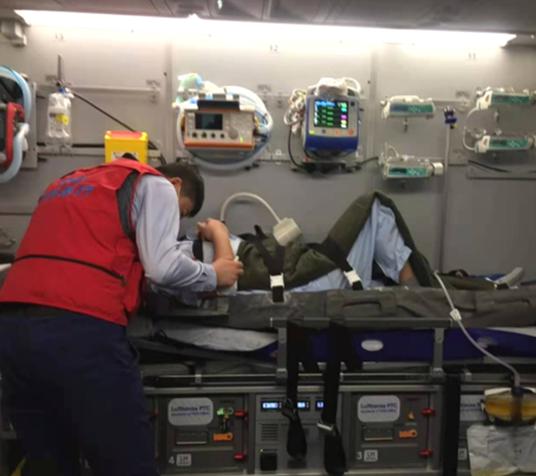
A commercial airline stretcher was installed on a scheduled flight from Surabaya to Hong Kong, with TKP providing bedside-to-bedside medical escort. Mr. Liu endured the six-hour flight with stable vitals, supported by onboard oxygen, suction, and ICU-grade monitoring.
Upon landing at Hong Kong International Airport, the patient was transferred to ambulance transport for the final leg via Shenzhen Bay Port, where customs clearance and health entry procedures were swiftly completed. Within an hour, he was en route to Guangzhou Medical University Second Affiliated Hospital.
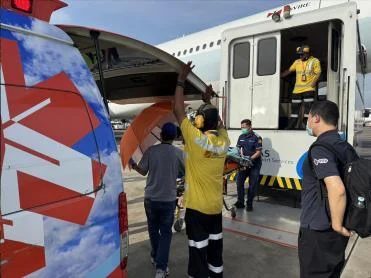
The TKP team loads the air stretcher onto the commercial flight bound for Hong Kong
Timely Admission and Family Gratitude in Guangzhou
By 6:00 PM the same day, Mr. Liu was safely admitted to the neurology ward in Guangzhou. His family expressed sincere thanks to TKP for their efficiency, professionalism, and full coordination throughout the repatriation process.
The hospital arranged a customized rehabilitation plan, combining neurocritical care, pulmonary support, and physical therapy to maximize his recovery potential.
A Growing Need for Cross-Border Emergency Medical Access
As the Belt and Road Initiative continues to expand China’s global footprint, more overseas workers may face complex medical challenges far from home. Mr. Liu’s case reflects a growing need for international coordination of emergency repatriation.
Companies and families must have access to reliable, affordable, and safe solutions when facing medical emergencies abroad.
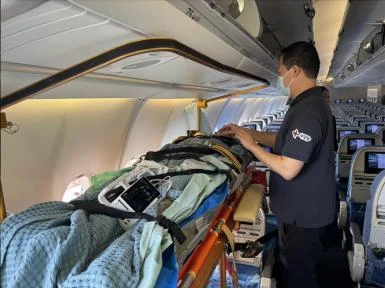
The patient receives ICU-level care during the six-hour flight from Surabaya to Hong Kong
TKP: Delivering Medical Dignity Across Borders
TKP Medical Assistance remains committed to providing safe, timely, and compassionate medical transport for Chinese nationals working, living, or traveling overseas. Through our global network and 20+ years of experience, we ensure that critically ill patients are never left behind—no matter where they fall ill.
Frequently Asked Questions
Need help understanding how international medical rescue works? Browse our most common questions to learn about service coverage, response times, documentation requirements, and more. We’re here to support you every step of the way.
Q: Which countries are covered by the cross-border medical rescue service?
A: We cover major countries and regions worldwide to ensure timely rescue
Q: How can I request cross-border medical rescue?
A: Please submit an emergency rescue request through our official website or customer service.
Q: What documents are needed for medical rescue?
A: Patient ID, medical diagnosis report, and emergency contact information are required.
Q: How is the rescue service fee settled?
A: Fees can be paid via insurance claims or direct payment for the service.
Q: How quickly does the rescue response start?
A: In emergencies, rescue operations typically begin within a few hours.
Submit Your Request
Recent Posts


Tags
- Air Ambulance
- Bedside To Bedside
- Cross Border Aid
- Emergency Evacuation
- Global Medical Rescue
- How can I ensure the patient's stability while in the air?
- How do I request an air medical transport?
- How is it different from an air ambulance
- how to activate emergency aircraft service
- how to request an air ambulance
- Is air medical transport safe
- Is international transport possible
- Medical Rescue
- Medical Transport
- Patient Repatriation
- Remote Rescue
- Seamless Coordination
- Telemedicine Support
- Tourists And Expats Medical Escort
- What are the benefits of a cross-border medical transfer
- What are the different types of transfers
- What are typical use cases
- What documents do I need to prepare for a transfer?
- What does high-speed rail patient transfer stands for
- What is air ambulance
- What is air medical transport?
- What is cross-border medical transfer
- What is emergency aircraft
- what is high-speed rail patient transfer
- What is medical charter flight
- what is neonatal ICU transfer
- What is patient air transfer
- What medical equipment is available on board the aircraft
- What situations shouldn't use air medical transport?
- What types of air ambulance are there?
- What types of air ambulance exist
- What's the difference between international and domestic transfers?
- what’s the difference between air medical transport and regular ambulance?
- When is emergency air transport necessary
- Which patients require air medical transport?
- who is included in the medical team
- who needs an air ambulance