


Insurance Approval for Flight Charter For Medical Emergencies: What Documents Are Required?


Insurance approval for a Flight Charter For Medical Emergencies is not obtained by submitting an aircraft quotation alone. The insurer must be able to follow a documented clinical argument from the patient’s current condition to the selected transport mode, destination, medical configuration and total cost.

From TKP Medical Assistance’s perspective, a strong authorization file should answer four questions:
•Does the policy include the requested benefit?
•Is medical transfer clinically necessary?
•Why is a dedicated flight required instead of another transport mode?
•Is the proposed destination medically appropriate and covered?
Requirements vary by policy, insurer and jurisdiction. Approval should never be assumed until it is confirmed in writing.
Insurance, Medical and Operational Approval Are Different
A Flight Charter For Medical Emergencies normally passes through three separate reviews.
| Review | Decision Maker | Evidence Required |
| Clinical fitness | Aviation medical physician | Current condition, physiological trends and in-flight risks |
| Insurance authorization | Insurer or assistance company | Policy eligibility, medical necessity, destination and cost |
| Operational feasibility | Flight operator and coordination team | Aircraft, crew, range, airports, permits and mission schedule |
Insurance authorization does not mean the patient is automatically fit to fly. Similarly, a medically transportable patient may not have coverage for repatriation to a preferred hospital or home country.
Verify the Benefit Definition First
Air ambulance, medical evacuation and medical repatriation may represent different policy benefits.
Medical evacuation usually concerns transfer to an appropriate facility when adequate treatment is unavailable locally. Medical repatriation may involve returning the patient to their country of residence, which can require a longer route and may not be included in the same benefit.
Before activating a Flight Charter For Medical Emergencies, TKP recommends checking:
•Coverage limit, deductible and co-payment;
•Prior-authorization requirements;
•Geographic or provider-network restrictions;
•Pre-existing-condition exclusions;
•”Nearest appropriate facility” wording;
•Home-country repatriation provisions;
•Emergency notification deadlines;
•Direct billing or guarantee-of-payment procedures;
•Cancellation and non-covered cost conditions.
Some policies may reduce or decline reimbursement when required pre-authorization is not obtained. Emergency exceptions and retrospective review procedures remain policy-specific.
Build a Structured Clinical File
The medical file should describe the patient’s current condition—not simply repeat the admitting diagnosis.
| Clinical Area | Information to Provide |
| Neurological | GCS, pupil findings, seizure activity, sedation and neurological trend |
| Respiratory | SpO₂ trend, oxygen flow, blood gases, airway status and ventilator settings |
| Cardiovascular | Blood pressure trend, rhythm, vasopressor dose and recent instability |
| Trauma or surgery | Procedure date, bleeding risk, drains, chest tubes and wound condition |
| Medication | Continuous infusions, analgesia, anticoagulation and time-critical drugs |
| Infection | Isolation status, microbiology results and required precautions |
| Mobility | Weight, positioning restrictions, pressure-injury risk and transfer method |
For ventilated patients, the file should include ventilation mode, FiO₂, PEEP, tidal volume, airway type and recent blood-gas results. For patients receiving vasoactive medication, the dose and trend are more useful than a general statement such as “hemodynamically stable.”
Useful documents include:
•Passport, insurance card and policy number;
•Current medical summary and diagnosis;
•Nursing observations and recent vital-sign trends;
•Laboratory, imaging and operative reports;
•Current medication and infusion list;
•Physician-signed medical-necessity statement;
•Fit-to-fly assessment;
•Information-release authorization;
•Receiving-hospital acceptance;
•Bed-to-bed mission plan;
•Itemized transport quotation.
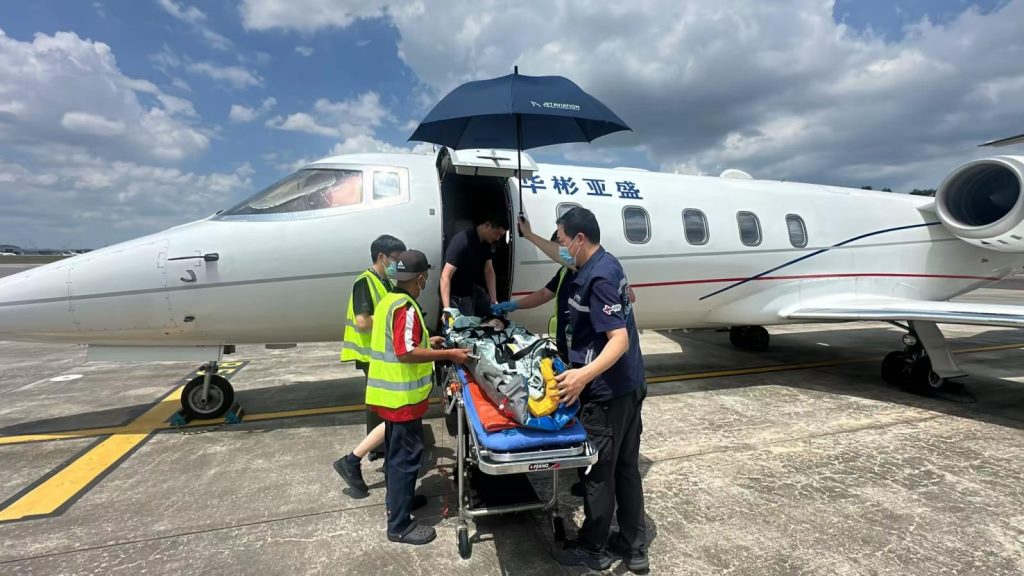
Medical Necessity Must Defend the Transport Mode
A medical-necessity letter for a Flight Charter For Medical Emergencies should explain why transport is needed and why the proposed mode is appropriate.
It should address:
•Treatment or specialist capability unavailable locally;
•Clinical consequences of delaying transfer;
•Monitoring and intervention required during transport;
•Oxygen, ventilation, medication or airway requirements;
•Why prolonged ground transport is unsafe or impractical;
•Why a commercial flight cannot provide the required environment;
•Why continuous bedside-level supervision is necessary.
For example, “patient requires air ambulance” is a conclusion, not supporting evidence. A stronger explanation would identify recent desaturation, current oxygen demand, risk of respiratory deterioration and the need for ventilatory rescue capability.
Official ambulance documentation principles similarly require records that are consistent with the patient’s current condition and explain why ambulance transport is necessary.CMS
The Destination Must Be Clinically Defensible
Insurance reviewers may question a distant destination when comparable treatment is available closer to the patient.
The authorization file should confirm:
•Required specialty and definitive treatment;
•Whether that treatment is unavailable at the current hospital;
•Name of the receiving physician;
•Formal hospital acceptance and bed status;
•Reason for selecting that facility;
•Whether the destination meets the policy’s definition of an appropriate facility.
A request to return home for convenience is evaluated differently from an emergency transfer for unavailable neurosurgery, cardiac intervention or critical care.
The Mission Plan and Quotation Must Match
A quotation for Flight Charter For Medical Emergencies should correspond directly with the clinical plan. It should identify:
•Aircraft type and proposed route;
•Direct flight or technical stop;
•Medical team composition;
•Monitoring, ventilator and infusion equipment;
•Planned oxygen supply and operational reserve;
•Ground ambulances at both ends;
•Airport handling and medical clearances;
•Included services, exclusions and cancellation terms.
If the records describe a ventilated ICU patient but the quotation does not specify a ventilator, oxygen reserve or appropriately qualified medical team, the submission appears incomplete.
A Practical Authorization Workflow
At TKP Medical Assistance, the coordination sequence generally follows:
- Verify the policy and authorization contact.
- Obtain consent to exchange clinical information.
- Collect updated records from the treating hospital.
- Complete the aviation medical assessment.
- Confirm the receiving hospital and bed.
- Design the bed-to-bed transport plan.
- Submit the medical rationale and itemized quotation.
- Respond to insurer medical-review questions.
- Obtain written authorization or payment arrangements.
- Confirm aircraft, medical crew, permits and schedule.
A telephone discussion or case number should not be treated as a guarantee of payment.
Why Approval Is Delayed or Denied
Common causes include:
•Outdated clinical records;
•Missing physician signature;
•No objective evidence supporting air transport;
•Unconfirmed receiving hospital;
•Destination outside policy conditions;
•Evacuation covered but repatriation excluded;
•Incomplete quotation or unclear exclusions;
•Failure to obtain required pre-authorization;
•A clinically suitable, lower-cost alternative being available.
When a request is denied, ask for the precise policy and medical basis. The next step may involve additional clinical evidence, physician-to-physician review, a revised destination, an alternative transport mode or a formal appeal.
When the Case Is Time-Critical
If waiting for approval could harm the patient, the treating physician should document the expected consequences of delay. TKP can request accelerated review and clarify whether emergency notification or retrospective assessment is permitted.
However, retrospective reimbursement is never guaranteed. Families should preserve written records of clinical recommendations, calls, emails, quotations and payment discussions.
Coordinating the Documentation With TKP
A successful Flight Charter For Medical Emergencies requires the clinical record, destination, transport configuration and quotation to present one consistent case.
TKP Medical Assistance can coordinate with the treating and receiving hospitals, arrange aviation medical review, develop the bed-to-bed plan and prepare clear information about the medical crew, equipment, route and cost scope. While the insurer retains final authority over coverage, complete documentation can reduce avoidable questions and delays.
If a patient may require a Flight Charter For Medical Emergencies, contact TKP Medical Assistance for an initial case assessment and a structured list of the documents needed to advance clinical and insurance review.
FAQs
Q1. Can TKP Medical Assistance obtain insurance approval for a medical flight?
TKP Medical Assistance can organize the clinical and operational documentation, communicate with relevant parties and respond to additional information requests. However, the insurer retains final authority over coverage and payment approval.
Q2. What information does TKP need for an initial case review?
The initial review usually requires the patient’s diagnosis, current condition, hospital location, proposed destination, treating-doctor contact details and insurance information. Recent medical reports should be provided when available.
Q3. Can TKP collect medical records directly from the hospital?
With authorization from the patient or legal representative, TKP can coordinate with the treating hospital to obtain medical summaries, test results, medication lists and other information required for the aviation medical assessment.
Q4. Does TKP prepare the medical-necessity letter?
The treating physician normally signs the formal medical-necessity statement. TKP can identify the transport-related information that should be addressed, such as oxygen requirements, monitoring needs and why other transport modes may be unsuitable.
Q5. Does TKP provide an itemized quotation for insurance review?
TKP can prepare a quotation defining the aircraft, route, medical team, equipment, ground ambulances and other included services. Exclusions and cancellation conditions should also be clearly identified.
Submit Your Request
Recent Posts

Tags
- Air Ambulance
- Bedside To Bedside
- Cross Border Aid
- Emergency Evacuation
- Global Medical Rescue
- How can I ensure the patient's stability while in the air?
- How do I request an air medical transport?
- How is it different from an air ambulance
- how to activate emergency aircraft service
- how to request an air ambulance
- Is air medical transport safe
- Is international transport possible
- Medical Rescue
- Medical Transport
- Patient Repatriation
- Remote Rescue
- Seamless Coordination
- Telemedicine Support
- Tourists And Expats Medical Escort
- What are the benefits of a cross-border medical transfer
- What are the different types of transfers
- What are typical use cases
- What documents do I need to prepare for a transfer?
- What does high-speed rail patient transfer stands for
- What is air ambulance
- What is air medical transport?
- What is cross-border medical transfer
- What is emergency aircraft
- what is high-speed rail patient transfer
- What is medical charter flight
- what is neonatal ICU transfer
- What is patient air transfer
- What medical equipment is available on board the aircraft
- What situations shouldn't use air medical transport?
- What types of air ambulance are there?
- What types of air ambulance exist
- What's the difference between international and domestic transfers?
- what’s the difference between air medical transport and regular ambulance?
- When is emergency air transport necessary
- Which patients require air medical transport?
- who is included in the medical team
- who needs an air ambulance