


Medical Aircraft Safety Standards for Cross-Border Medical Evacuation in 2026


Cross-border medical evacuation is not simply a question of whether an aircraft can carry a stretcher. A safe mission must align aviation compliance, patient physiology, medical equipment, crew capability, route planning and ground-to-hospital coordination.

At TKP Medical Assistance, we view Medical Aircraft Safety Standards as a complete risk-control framework applied across the entire bed-to-bed transfer. There is no single global certificate that makes every medical flight compliant worldwide. Instead, each mission must be assessed against the regulations, operational approvals and clinical requirements relevant to the aircraft, operator, route and patient.
What Do Medical Aircraft Safety Standards Cover?
In practice, Medical Aircraft Safety Standards sit at the intersection of aviation regulation and critical-care transport.
A cross-border mission normally requires assessment of four layers:
•Aviation compliance: Aircraft airworthiness, operator authorization, maintenance and operational limitations.
•Clinical suitability: Whether the patient can tolerate the flight environment and transfer phases.
•Medical systems: Oxygen, ventilators, monitors, pumps, batteries and backup capability.
•Mission coordination: Airports, permits, ground ambulances, medical documentation and receiving-hospital acceptance.
In their respective territories, the FAA and EASA set aviation rules. At the international level, the rules are set by ICAO. Medical transport accreditation and setting standards in patient care is the focus of CAMTS. It does not replace regulations in aviation.
1. Aircraft and Operator Authorization Come First
One of the first Medical Aircraft Safety Standards checks should be identifying the actual operating carrier.
The company coordinating an evacuation is not necessarily the organization operating the aircraft. The operating carrier must have the appropriate authority for the mission, and the aircraft must be suitable for its intended operation.
For U.S. operations, FAA Part 135 certification can involve requirements covering aircraft, maintenance, manuals, training, minimum equipment and hazardous-material programs.
For a medical evacuation, the practical questions include:
•Who holds operational control of the flight?
•Is the specific aircraft authorized and airworthy?
•Is the medical configuration appropriately installed or secured?
•Can the aircraft complete the route with suitable fuel, range and cabin conditions?
This distinction becomes especially important when several brokers, assistance companies and aviation operators are involved.
2. Patient Fitness to Fly Is Mission-Specific
Hospital stability does not automatically mean fitness to fly.
Cabin altitude changes the partial pressure of oxygen and may affect patients with pulmonary, cardiac, neurological or hematological disease. Gas expansion may also be relevant in selected conditions.
Clinical planning should therefore consider:
•Diagnosis and recent clinical trend;
•Oxygen requirement at ground level;
•Ventilation mode and airway dependency;
•Hemodynamic stability;
•Recent surgery or trauma;
•Intracranial, thoracic or abdominal gas-related concerns;
•Likelihood of deterioration during loading or flight.
From the TKP perspective, the key question is not simply “Can the patient fly?” but “Under what aircraft, cabin, medical-team and equipment conditions can the patient be transported safely?”
3. Oxygen Planning Requires a Contingency Margin
Medical oxygen is one of the most operationally important areas within Medical Aircraft Safety Standards.
The oxygen calculation should cover more than scheduled airborne time. It may need to include:
Patient loading + Taxi + Flight time + Diversion exposure + Unloading + Operational reserve
The plan should address all oxygen-dependent systems including the use of ventilators and high-flow systems.
Medical oxygen cylinders are recognized as dangerous goods by transport authorities including the FAA. An air ambulance company would typically address the management of medical oxygen systems in its FAA air carrier certificate (Part 135) operations specification (See AC 120-45, Paragraph 3.a.). A dangerous goods program would address the acceptance and transport of such materials.
4. Medical Equipment Must Be Suitable for the Aircraft Environment
An ICU device is not automatically aviation-ready.
Medical Aircraft Safety Standards require planners to consider whether essential devices can continue functioning throughout the transport environment.
| System | Operational Safety Question |
| Ventilator | Can ventilation continue after a power or oxygen-source change? |
| Patient monitor | Can ECG, SpO₂ and other required parameters remain continuously visible? |
| Infusion pumps | Is battery duration sufficient for delays and transfer phases? |
| Defibrillator | Is it immediately accessible and adequately powered? |
| Suction | Is an independent or backup system available? |
| ECMO / advanced support | Are power, gas, securing and access requirements compatible with the aircraft? |
Portable medical electronic devices also require consideration of electromagnetic interference. FAA helicopter air-ambulance guidance, for example, discusses emission testing and evaluation of medical portable electronic devices.
5. Batteries and Dangerous Goods Cannot Be Treated as an Afterthought
Modern critical-care transport depends heavily on lithium-battery-powered equipment.
The mission team should know:
•Expected battery endurance;
•Number and condition of spare batteries;
•Charging capability aboard the aircraft;
•Procedures for damaged or overheating batteries;
•Applicable dangerous-goods restrictions.
For Part 135 operators, FAA rules require hazardous-material training programs, including for operators that declare they will not carry hazardous materials.
This is why equipment planning must involve both medical necessity and aviation compliance.
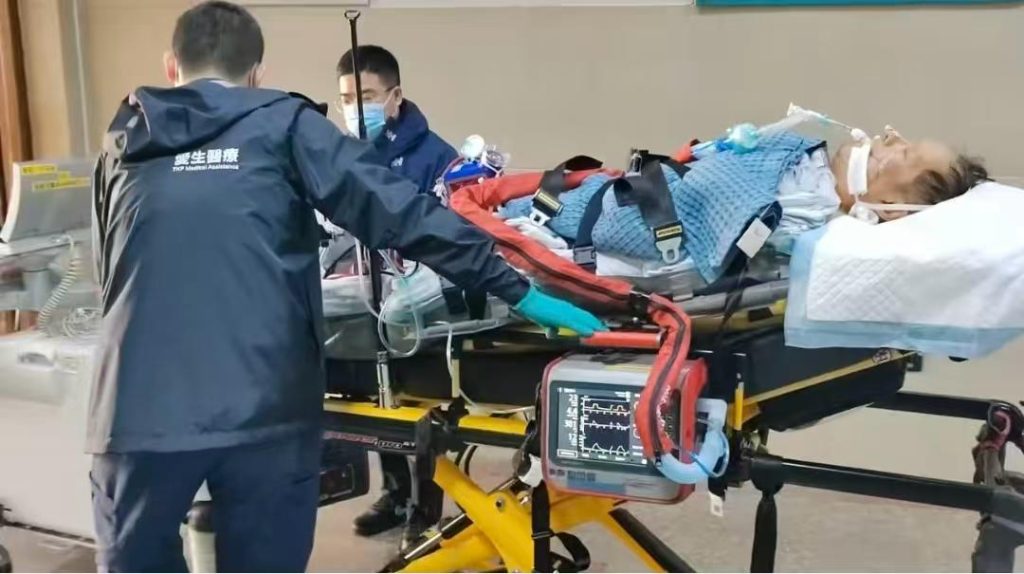
6. Patient Restraint, Equipment Securing and Weight & Balance
A stretcher-equipped aircraft is not automatically a properly configured medical aircraft.
Current FAA air-ambulance definitions reference medical oxygen, suction and an approved stretcher, isolette or other patient-restraint/containment device as relevant equipment.
During mission planning, Medical Aircraft Safety Standards should address:
•Stretcher attachment and patient restraint;
•Securing oxygen cylinders and medical equipment;
•Access to the patient during flight;
•Emergency-egress clearance;
•Total payload;
•Aircraft centre-of-gravity limitations.
Additional equipment improves capability only when it can be safely accommodated.
7. Extra Paperwork for International Evacuations
More paperwork and planning is required for international evacuations as compared to domestic ones, due to the presence of multiple countries and modes of transport (i.e. land, air and sea).
Aircraft or Operator country -> Over-Flight and/or Technical landing countries -> Destination Country and Hospital
International flights require advanced planning for landing permissions, immigration, and other formalities. Evacuees may also require the services of ground ambulance and airport staff.
The amended Easy Access Rules and the updated TCO Rules issued by the EASA in 2026, simplified and standardized the procedures for operating different kinds of aircrafts (manned and unmanned) within the European Union.
8. Crew Capability and Human Factors Matter
Medical Aircraft Safety Standards concern people as much as aircraft.
A mission should match the medical crew to the patient’s dependency level. A stable stretcher patient and an intubated patient receiving multiple vasoactive infusions clearly require different clinical resources.
Operational safety also depends on:
•Crew duty and fatigue;
•Clear medical handovers;
•Defined operational control;
•Cockpit–medical-team communication;
•Escalation plans when conditions change.
Human factors become particularly important on long-range missions involving multiple sectors and extended duty periods.
A Practical Pre-Flight Safety Review
Before an international medical evacuation proceeds, the case should answer these questions:
- Is the patient clinically suitable for the proposed flight profile?
- Is the aircraft and actual operator appropriate for the mission?
- Can oxygen, power and essential treatment continue with adequate reserve?
- Are the patient and all equipment safely restrained?
- Are route, permits, documentation and ground transfers confirmed?
- Has the receiving hospital accepted the patient?
- What is the contingency plan for delay, diversion or clinical deterioration?
These are the operational decisions that turn Medical Aircraft Safety Standards from written requirements into practical patient protection.
What Is Changing in 2026?
Regulatory changes impact us all. EASA published its latest revision to Air Operations in March 2026, bringing the latest changes to European operational regulations. Meanwhile, CAMTS is working on the 13th edition of its Transport Standards. Effective from 1 January 2027, these changes are expected to introduce a number of modifications to its current standards.
International air ambulance companies need to regularly monitor and adjust to these changes.
Safe Medical Evacuation Is a System, Not a Single Aircraft
The most important lesson about Medical Aircraft Safety Standards is that safety does not come from one aircraft, one medical device or one certificate. It comes from correctly matching the patient’s clinical requirements with the aircraft, operator, medical crew, equipment, route and receiving facility.
At TKP Medical Assistance, we approach international medical evacuation as a coordinated bed-to-bed process—from initial clinical assessment and flight planning to medical equipment, ground ambulance arrangements and hospital handover.
If you are evaluating a cross-border medical evacuation, TKP Medical Assistance can review the medical and operational requirements of the case and help coordinate an appropriate transfer plan.
FAQs
Q1. What are Medical Aircraft Safety Standards?
Medical Aircraft Safety Standards cover aircraft operation, patient safety, medical equipment, oxygen systems, crew capability and mission planning for medical flights.
Q2. Does TKP Medical Assistance operate its own medical aircraft?
TKP Medical Assistance coordinates medical evacuation cases with suitable aviation and medical resources based on the patient’s condition, route and transfer requirements.
Q3. How does TKP Medical Assistance assess whether a patient is fit to fly?
The assessment considers diagnosis, clinical stability, oxygen needs, ventilation, recent procedures, mobility and the risks associated with the planned flight environment.
Q4. How does TKP Medical Assistance select an aircraft for medical evacuation?
Aircraft selection is based on patient condition, required medical equipment, route distance, cabin configuration, airport access and operational requirements.
Q5. How is medical oxygen planned for an air ambulance flight?
Oxygen planning considers patient consumption, flight duration, loading and unloading time, possible delays and an appropriate contingency reserve.
Submit Your Request
Recent Posts


Tags
- Air Ambulance
- Bedside To Bedside
- Cross Border Aid
- Emergency Evacuation
- Global Medical Rescue
- How can I ensure the patient's stability while in the air?
- How do I request an air medical transport?
- How is it different from an air ambulance
- how to activate emergency aircraft service
- how to request an air ambulance
- Is air medical transport safe
- Is international transport possible
- Medical Rescue
- Medical Transport
- Patient Repatriation
- Remote Rescue
- Seamless Coordination
- Telemedicine Support
- Tourists And Expats Medical Escort
- What are the benefits of a cross-border medical transfer
- What are the different types of transfers
- What are typical use cases
- What documents do I need to prepare for a transfer?
- What does high-speed rail patient transfer stands for
- What is air ambulance
- What is air medical transport?
- What is cross-border medical transfer
- What is emergency aircraft
- what is high-speed rail patient transfer
- What is medical charter flight
- what is neonatal ICU transfer
- What is patient air transfer
- What medical equipment is available on board the aircraft
- What situations shouldn't use air medical transport?
- What types of air ambulance are there?
- What types of air ambulance exist
- What's the difference between international and domestic transfers?
- what’s the difference between air medical transport and regular ambulance?
- When is emergency air transport necessary
- Which patients require air medical transport?
- who is included in the medical team
- who needs an air ambulance