


What Medical Conditions Require Air Ambulance Cross-Border Medical Transport?


How should patients be moved during a medical emergency that happens far away from home? This is especially a concern in remote areas with limited access to healthcare. Cross-border medical transport through air ambulances is a critical option for patients when travel is unsafe or there is an urgent need for care that is outside the local healthcare system.

What makes some medical conditions even more critical? Below, we describe the different types of conditions that require cross-border medical transport through air ambulances and support them with evidence.
Cardiovascular Emergencies as Air Transport
Air medical transport is most often indicated for cardiovascular conditions. Of the 586 medical cases studied, 35.8% involved some type of cardiovascular condition, making it the largest category in that study.
The following conditions present a clear need for air ambulance transport:
• Myocardial Infarction (Heart Attack): The absence of an angioplasty or surgical team in most countries makes it impossible for a patient who has suffered a heart attack to survive.
• Acute Events in Congestive Heart Failure: Patients who suffer sudden deterioration of a chronic heart condition will need ICU-level care during transport. This is also not possible on a commercial flight.
• Recovery Period after Open Heart Surgery: Patients who have undergone open heart surgery to bypass a coronary artery or to replace a heart valve also need medical supervision during repatriation.
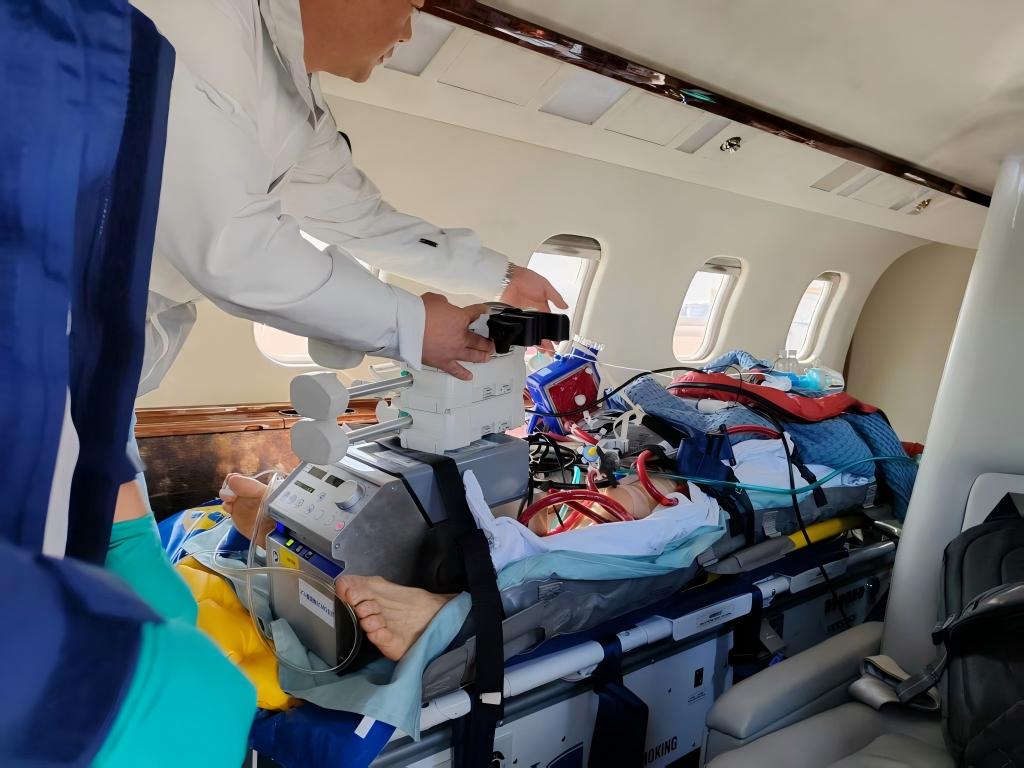
• Patients in Need of Intra-Aortic Balloon Pumps or Ventricular Assist Devices: Some air ambulances can aid patients with advanced stages of cardiac support including ECMO (extracorporeal membrane oxygenation).
Neurological and Central Nervous System Conditions
Central nervous system diseases are the second most prevalent reason in air medical transport comprising nearly 20.4% of air medical transports.
Commonly transported neurological conditions include the following:
•Cerebrovascular Accident (Stroke): Studies suggest strokes are the third most common reason for an air medical transport comprising nearly 14% of air medical transports of adults. “Time is brain” is the popular phrase amongst medical personnel who agree practice confirms that patients with a CVA or stroke require the fastest medical transport to a STEMI stroke center.
•Traumatic Brain Injury: Severe traumatic brain injury often requires air shuttle transport to/from a given country when the local country’s facility fails to provide neurosurgery.
•Intracranial Hemorrhage: A 51-year-old male suffered a hypertensive intracerebral hemorrhage while on the job somewhere in Africa. He was air evacuated from the Democratic Republic of the Congo to Shanghai a journey of over 40 hours.
•Spinal Injury: Patients who have sustained an injury to a vertebra or spinal cord from an accident are treated with the utmost care for the support and stabilization of their vertebra or spine.
Severe Trauma and Polytrauma
Trauma cases—particularly those involving multiple injuries—are among the most common reasons for air ambulance evacuation, especially in pediatric populations where trauma surgery accounts for 39.5% of transports.
Trauma conditions that warrant air ambulance transport include:
•Motor vehicle accidents with multiple fractures: Complex fractures, including femoral neck fractures (which account for approximately 15% of adult aeromedical evacuations), often require transport to orthopedic specialty centers.
•Severe burns: Burn patients need specialized wound care and infection control that might not be available locally.
•Combined spinal and head injuries with other trauma: An air ambulance successfully transported a patient from Sri Lanka with severe traumatic brain injury, oral and maxillofacial injuries, multiple rib fractures, and hemopneumothorax for 4,660 kilometers to China.
•Internal bleeding and crush injuries: These life threatening conditions need prompt transport to trauma centers with surgical capability.
Respiratory & Pulmonary Conditions
Many patients with serious lung problems are unable to travel on commercial airlines because of the dangers of changes in cabin pressure and the need for ongoing oxygen therapy.
Respiratory conditions that require air ambulance transport include:
•Respiratory failure: Patients requiring mechanical ventilation require ICU-level care in transport.
•Severe pneumonia and sepsis: The patient transported from Africa had pneumonia and sepsis with concurrent intracranial hemorrhage. These cases require multi-system monitoring.
•Acute exacerbations of chronic obstructive pulmonary disease (COPD). Elderly travellers with chronic respiratory conditions may suffer an acute deterioration requiring supervised repatriation.
•Pneumothorax or hemothorax: Chest tube management is necessary in transport if these conditions are present.
Pediatric and Neonatal Transport
Neonatal transport is one of the most specialized services in aeromedical care, these missions include the smallest and most fragile patients.
Air ambulance transport may be required for newborns and infants who:
•Premature infants: Premature infants (born before 37 weeks) may need advanced respiratory support, temperature regulation, and feeding assistance only available at Level III or Level IV NICUs.
•Congenital heart defect infants: Infants born with surgical congenital heart defects will likely need transfer to a pediatric cardiac surgical center.
•Neonates with respiratory distress syndrome: Infants born with RDS will require specialty transport as a neonatal ventilator will be required along with staff trained in neonatology.
•Infants requiring ECMO support: Some neonatal transport teams have the capability to perform ECMO supported transports with incubators and personnel trained in pediatrics on board.
Pediatric air ambulances require isolettes (portable incubators), specialized ventilators designed for newborns, and precise control of temperature, oxygen and vibration.
Specialty Care and Organ Transplant
Patients who require highly specialised treatment or are awaiting an organ transplant often need to travel across borders to designated transplant centres or specialised facilities.
Transplant related transports are:
•Candidates for organ transplant: Patients needing urgent transfer to a transplant centre
•Patients requiring specialized treatment not available locally: If a patient requires advanced imaging, surgical expertise, or experimental therapies that are not available in their area
•Patients with cancer who need specialized oncology care
Other Critical Conditions
Other common conditions requiring cross-border medical transport by air ambulance include:
•Patients with serious infections requiring intensive care who do not have access to this level of care locally
•Post-surgical complications: Patients who develop complications after surgery abroad may require repatriation for further treatment
•High-risk pregnancies and obstetric emergencies: Pregnant patients with complications may require transport to facilities with specialized maternal-fetal medicine services
•Acute deterioration in patients with chronic conditions: Elderly travelers with diabetes, heart disease or other chronic illnesses may develop complications suddenly, which may require medical supervision during transport.
•Patients with mobility limitations: Paralysis, severe fractures, or other conditions that prevent commercial travel.
When is the Right Time for Air Ambulance Transport?
“Air ambulance is not necessary for every medical condition. In general, medical professionals feel air ambulance transport is appropriate for:
•Too risky, too slow, or impossible to transport by ground due to distance, terrain or the patient’s condition
•The patient has to travel more than 250 miles for specialist medical care
•Medically contraindicated. Commercial air travel not advised patient cannot sit upright safely or requires continuous medical intervention
•The patient needs intensive care level monitoring and equipment for transit including ventilators cardiac monitors and infusion pumps
•Medical facilities locally are limited – the hospital lacks specialist surgeons, advanced imaging or intensive care capabilities
Bottom Line
Air ambulance cross-border medical transport covers a broad range of conditions, from cardiovascular emergencies and neurological crises to severe trauma, neonatal critical care, and organ transplant coordination. Cardiovascular disease continues to be the most common indication, followed closely by central nervous system conditions, with trauma and pediatric cases comprising major additional categories.
The use of an air ambulance is never a lightly made decision. This requires a thorough clinical assessment of patient stability, distance, level of care required during transport and capabilities of the referring and receiving facilities. When these factors are favorable, air ambulance transport can be a life-saving link between suboptimal local care and definitive care at a specialty medical center .
Your Partner in Cross-Border Medical Evacuations
TKP Medical Assistance is the pioneer of cross-border medical transfer and air ambulance in China and the Greater Bay Area. Founded in 2001, we have carried out over 10,000 missions including air ambulance, commercial stretcher and high speed rail transfers. We are experts in ICU transport, ECMO, pediatric and VIP medical evacuations. With 24+ years experience, multilingual coordination and a dedicated team of ICU/ER trained medical professionals, we provide seamless bed-to-bed continuity of care 24/7. Your safety is our mission. Call TKP Medical Assistance for trusted, clinically-guided cross-border transport.
FAQs
Q1: What medical equipment is on board a cross-border air ambulance?
A: Cross-border air ambulances are fitted as standard with ICU grade equipment such as ventilators, infusion pumps, and cardiac monitors. Other equipment includes suction, oxygen, and portable defibrillator supplies. Some air ambulances are also equipped with ECMO and incubators.
Q2: Air transporting premature babies and newborns, is that safe?
A: Yes, it is safe to air transport these babies. Specialized pediatric and neonatal teams provide safe transportation for these small patients using incubators, pediatric ventilators, and controlled temperature transport.
Q3: What paperwork is needed for an International Medical Repatriation?
A: For an International Medical Repatriation, travelers need to provide a valid passport, a visa if required, detailed medical documentation, letters of medical clearance, and flight permission from both the overflying and landing country, all of which are supplied by the medical repatriation service.
Q4: How is the receiving hospital assured?
A: The air ambulance service will liaise with the hospital to assure the acceptance and the receiving specialist and provide the patient for the transport “bed to bed.”
Q5: How do I select a reliable cross-border air ambulance?
A: The best way to select a reliable cross-border air ambulance service is to look for the desired credentials such as EURAMI and CAMTS, years of experience, uninterrupted service, multi-language support, and verifiable cases. An excellent example is TKP Medical Assistance which has more than 10,000 missions since 2001.
Submit Your Request
Recent Posts

Tags
- Air Ambulance
- Bedside To Bedside
- Cross Border Aid
- Emergency Evacuation
- Global Medical Rescue
- How can I ensure the patient's stability while in the air?
- How do I request an air medical transport?
- How is it different from an air ambulance
- how to activate emergency aircraft service
- how to request an air ambulance
- Is air medical transport safe
- Is international transport possible
- Medical Rescue
- Medical Transport
- Patient Repatriation
- Remote Rescue
- Seamless Coordination
- Telemedicine Support
- Tourists And Expats Medical Escort
- What are the benefits of a cross-border medical transfer
- What are the different types of transfers
- What are typical use cases
- What documents do I need to prepare for a transfer?
- What does high-speed rail patient transfer stands for
- What is air ambulance
- What is air medical transport?
- What is cross-border medical transfer
- What is emergency aircraft
- what is high-speed rail patient transfer
- What is medical charter flight
- what is neonatal ICU transfer
- What is patient air transfer
- What medical equipment is available on board the aircraft
- What situations shouldn't use air medical transport?
- What types of air ambulance are there?
- What types of air ambulance exist
- What's the difference between international and domestic transfers?
- what’s the difference between air medical transport and regular ambulance?
- When is emergency air transport necessary
- Which patients require air medical transport?
- who is included in the medical team
- who needs an air ambulance