


International Air Ambulance Service: A Complete Patient Transfer Guide


An international Air Ambulance Service is a mobile critical-care pathway, not simply a charter flight with a stretcher. A successful transfer must align the patient’s clinical condition, aircraft capability, medical equipment, ground transport, border clearance and receiving-hospital readiness.

At TKP Medical Assistance, we begin with the clinical requirement. Aircraft type, route and medical team are selected only after the patient’s risks and treatment needs have been reviewed.
An International Transfer Starts With Four Clearances
A patient who appears stable in hospital may still deteriorate during ground handling, takeoff, reduced cabin pressure or a long flight. Before activating an Air Ambulance Service, four conditions should be confirmed:
•Clinical clearance: The transport physician accepts the patient as fit for the proposed flight profile.
•Sending clearance: The current hospital provides an updated medical report and completes discharge arrangements.
•Receiving clearance: A named physician and suitable bed are confirmed at the destination.
•Operational clearance: Aircraft availability, airport access, permits, visas and ground ambulances are coordinated.
Recent progress notes, diagnosis, oxygen demand, ventilator settings, intravenous medication, infection status, patient weight and mobility limitations are more useful than a short discharge summary alone.
TKP’s medical transport process converts these records into a route-and-mode plan before resources are activated.
Cabin Conditions Change the Clinical Plan
Cabin Pressure Is a Medical Parameter
A pressurized aircraft does not reproduce sea-level hospital conditions. Reduced cabin pressure lowers oxygen partial pressure and causes trapped gases to expand. This may be significant for patients with pulmonary disease, untreated pneumothorax, recent abdominal procedures, certain eye surgeries or intracranial pathology.
The medical team must consider:
•Expected cabin altitude;
•Baseline and oxygen-supported saturation;
•Risk of gas expansion;
•Ability to manage sudden respiratory deterioration;
•Whether a lower-cabin-altitude flight profile is required.
The final decision must be made by the assigned transport clinician—not by applying a universal oxygen saturation threshold.
Equipment & Aircraft Selection
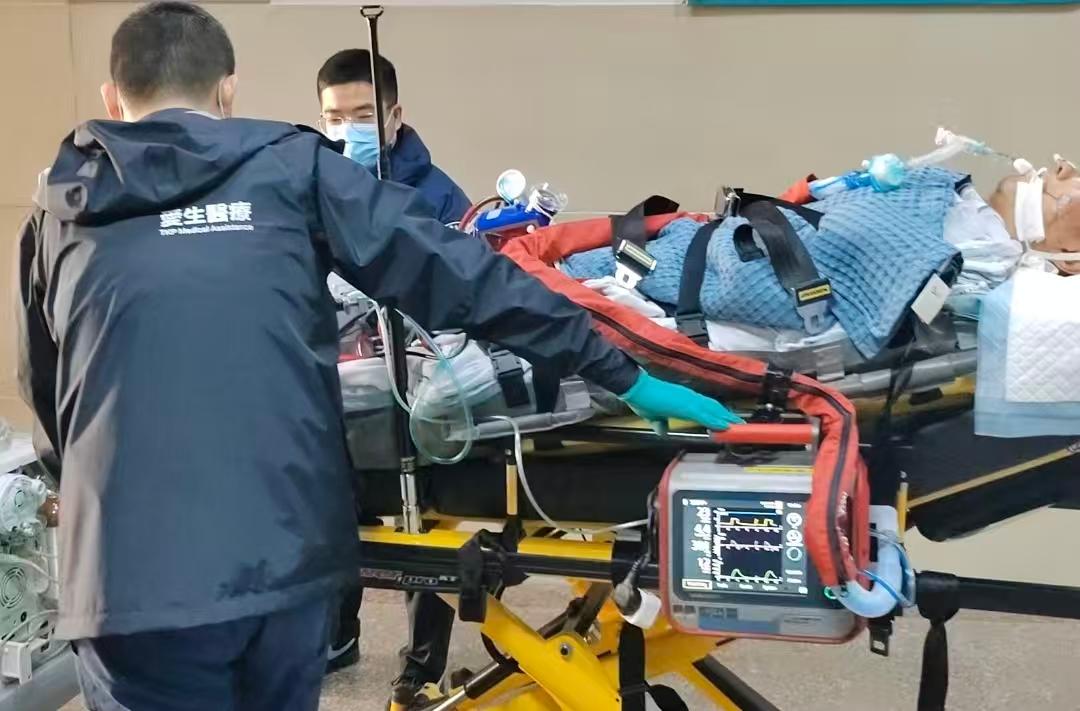
For TKP missions, we configure portable ALS or ACLS systems with transport-ready ICU monitors, oxygen, ventilators and, when clinically required, ECMO. Equipment is selected for the patient’s age, size and clinical condition rather than added as a generic package.
Compare the Transfer Options Before Selecting an Aircraft
| Decision | Option A | Option B | Technical Deciding Factor |
| Transport mode | Dedicated Air Ambulance Service | Commercial stretcher or medical escort | Acuity, intervention frequency and equipment needs |
| Aircraft | Medical jet | Turboprop | Route length, airport access, speed and cabin environment |
| Flight plan | Direct flight | Technical fuel stop | Loaded mission range and patient tolerance |
| Medical team | Adult ICU team | Neonatal, pediatric or ECMO team | Diagnosis, age and life-support system |
| Contract model | Actual aircraft operator | Medical coordinator using an approved operator | AOC responsibility and contract transparency |
A commercial stretcher may suit a stable bedridden patient who has airline medical approval. A seated medical escort is appropriate only when the patient can tolerate the airline environment and limited treatment space.

A dedicated Air Ambulance Service is more appropriate when the patient needs invasive ventilation, titrated medication, continuous hemodynamic monitoring or rapid intervention. TKP can also evaluate ground ambulance and high-speed rail for suitable regional cases instead of automatically recommending air transport.
Match Payload, Range and Cabin Access as One System
Maximum published aircraft range is not the same as usable medical-mission range. The actual payload includes:
•Patient and accompanying relative;
•Pilots and medical team;
•Stretcher and restraint system;
•Oxygen cylinders;
•Monitor, ventilator, pumps and suction;
•Medication, consumables and baggage.
Additional payload may limit the fuel that can be carried, potentially turning a theoretical direct flight into a multi-stop route. Weather, alternate-airport fuel and runway limitations must also be included.
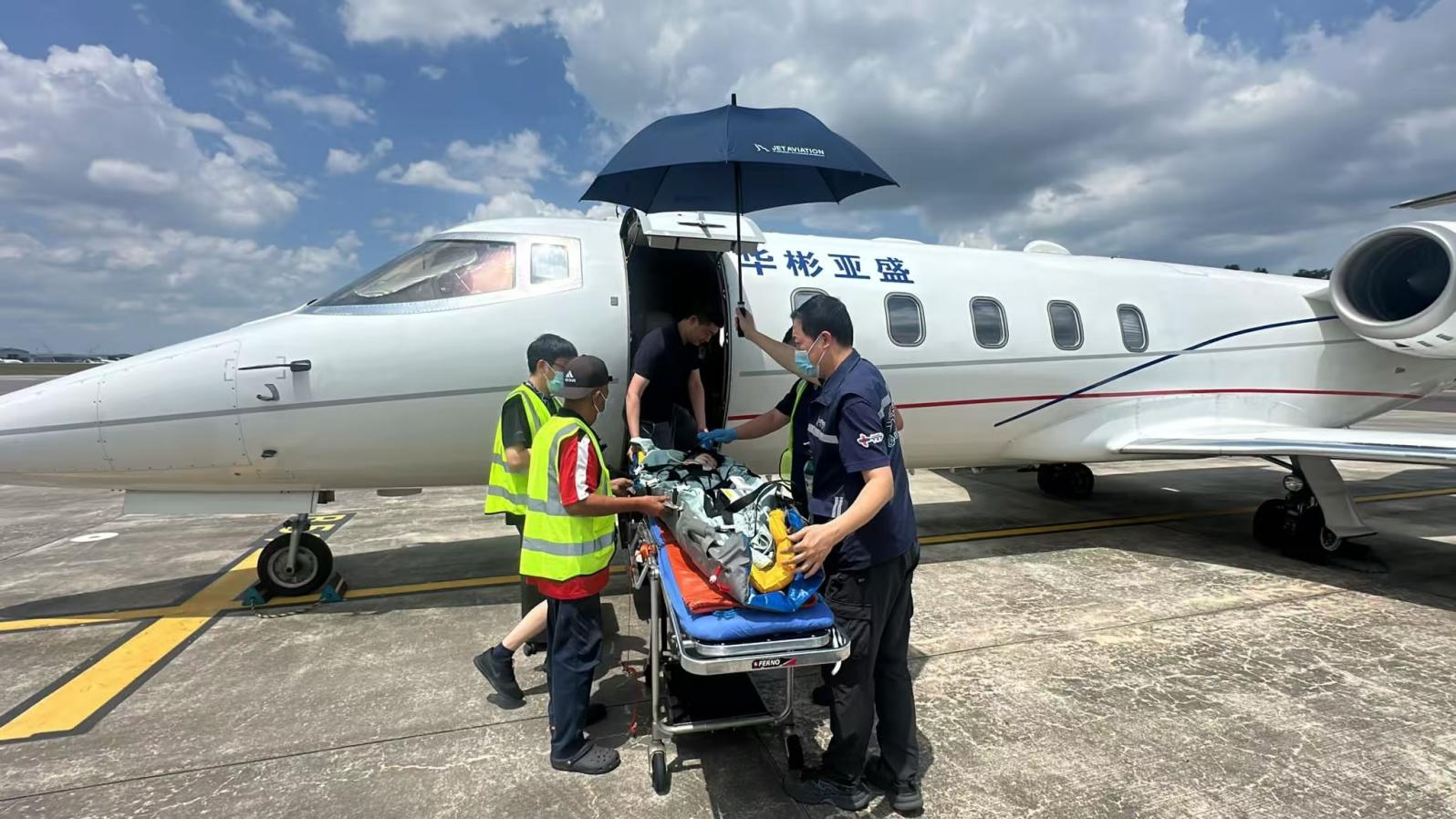
Cabin access matters as much as range. Before confirming the Air Ambulance Service, the team should verify the door opening, stretcher loading angle, patient weight limit, working height and access to the airway and intravenous lines.
Equipment Installation and Care Continuity
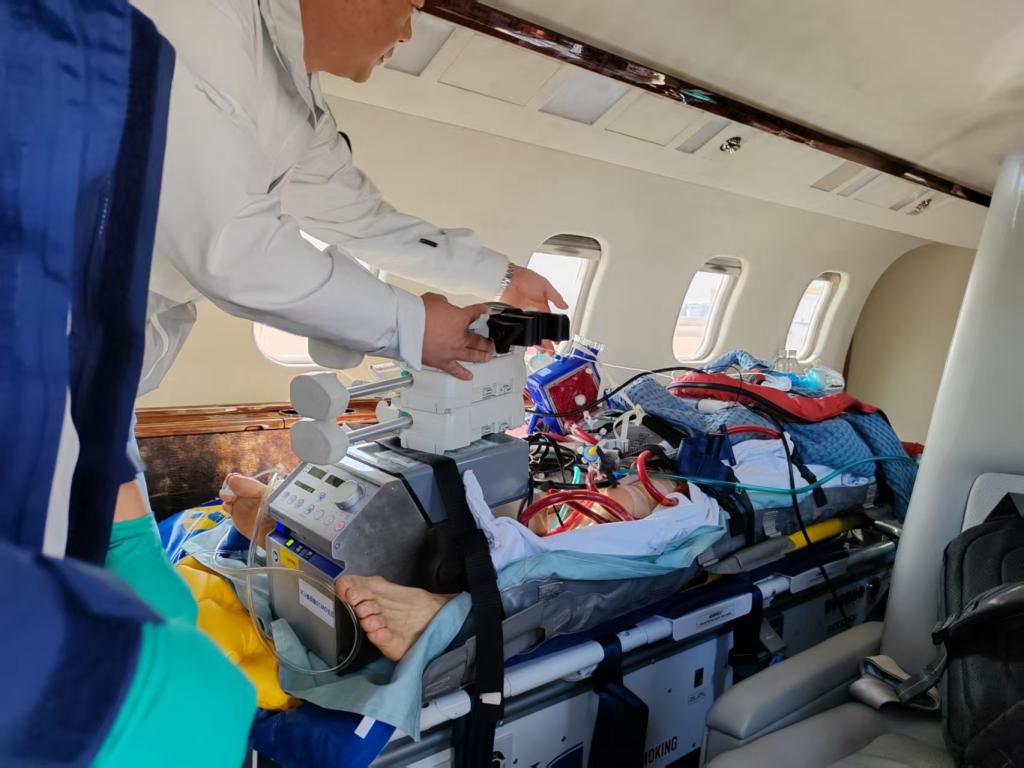
Medical devices cannot simply be placed beside the patient. Before departure, our operational checklist addresses:
•Approved stretcher and patient-restraint points;
•Secure mounting of monitors, ventilators and pumps;
•Oxygen regulator, tubing and reserve-supply checks;
•Electrical load, connectors and battery status;
•Medication quantities and temperature requirements;
•Emergency access to the patient during turbulence.
At the bedside, the flight team confirms lines, drains, airway position, medications and current device settings with the sending clinician. Monitoring continues through every vehicle change. At destination, TKP provides a structured handover to the receiving team. Equipment is then inspected, replenished and disinfected before another mission.
Verify the Provider, Operator and Medical Scope
A reputable Air Ambulance Service should distinguish medical accreditation from legal aviation authority.
Buyers should request:
•The actual aircraft operator’s current AOC or equivalent authorization;
•Aircraft registration and appropriate insurance;
•Approval for the stretcher and medical installation;
•Assigned clinicians’ licenses and transport experience;
•The scope and validity of any CAMTS or EURAMI accreditation;
•Evidence that medical-device interfaces meet applicable EN 13718 requirements;
•Infection-control and port-health procedures where relevant.
A coordinator’s experience does not replace the operating carrier’s aviation approval. Likewise, a general accreditation should not be presented as proof of neonatal, ECMO or long-haul capability unless that scope is specifically covered.
Read the Air Ambulance Service Quote Line by Line
A complete quotation should identify:
•Aircraft positioning and flight hours;
•Direct flight or planned fuel stops;
•Airport, handling and permit charges;
•Medical team and specialist equipment;
•Ground ambulances at both ends;
•Companion arrangements;
•Insurance documentation support;
•Delay, cancellation and clinical-change terms.
TKP Medical Assistance has coordinated cross-border medical transfers since 2001 and reports more than 10,000 completed missions across air, commercial stretcher, rail and ground transport. Our multilingual coordinators work with hospitals, families, aviation partners and insurers throughout the transfer.
For a case-specific Air Ambulance Service plan, TKP can review the medical report, route, timetable and receiving-hospital information before preparing an itemized bed-to-bed proposal.
FAQs
Q1. What medical transport services does TKP Medical Assistance provide?
TKP coordinates dedicated air ambulance flights, commercial-flight stretcher transfers, medical escorts, ground ambulances and high-speed rail medical transfers. The mode is selected according to the patient’s condition, route and required care level. See TKP’s medical transport services.
Q2. How to request an Air Ambulance Service from TKP?
Provide the patient’s recent medical report, diagnosis, vital signs, treatment plan, departure location and intended receiving hospital. TKP then conducts a clinical review, develops a route and transport plan, and prepares a quotation.
Q3. Does TKP provide bed-to-bed patient transfers?
Yes. Depending on the agreed scope, TKP can coordinate pickup from the sending hospital, ground ambulance transport, airport handling, in-transit care and final handover at the receiving facility.
Q4. What medical equipment is available during a TKP mission?
TKP reports using portable ALS or ACLS systems, ICU monitors, oxygen supplies, ventilators, suction equipment and infusion pumps. ECMO support can be arranged when clinically necessary. Equipment is configured for the individual patient.
Q5. Can TKP transport ventilated or ICU patients?Yes. TKP provides critical-care transfers supported by ICU- or emergency-trained physicians and nurses. Each case requires a pre-transfer assessment of ventilation, oxygen demand, medication, hemodynamic stability and expected journey time.
Submit Your Request
Recent Posts
Tags
- Air Ambulance
- Bedside To Bedside
- Cross Border Aid
- Emergency Evacuation
- Global Medical Rescue
- How can I ensure the patient's stability while in the air?
- How do I request an air medical transport?
- How is it different from an air ambulance
- how to activate emergency aircraft service
- how to request an air ambulance
- Is air medical transport safe
- Is international transport possible
- Medical Rescue
- Medical Transport
- Patient Repatriation
- Remote Rescue
- Seamless Coordination
- Telemedicine Support
- Tourists And Expats Medical Escort
- What are the benefits of a cross-border medical transfer
- What are the different types of transfers
- What are typical use cases
- What documents do I need to prepare for a transfer?
- What does high-speed rail patient transfer stands for
- What is air ambulance
- What is air medical transport?
- What is cross-border medical transfer
- What is emergency aircraft
- what is high-speed rail patient transfer
- What is medical charter flight
- what is neonatal ICU transfer
- What is patient air transfer
- What medical equipment is available on board the aircraft
- What situations shouldn't use air medical transport?
- What types of air ambulance are there?
- What types of air ambulance exist
- What's the difference between international and domestic transfers?
- what’s the difference between air medical transport and regular ambulance?
- When is emergency air transport necessary
- Which patients require air medical transport?
- who is included in the medical team
- who needs an air ambulance